


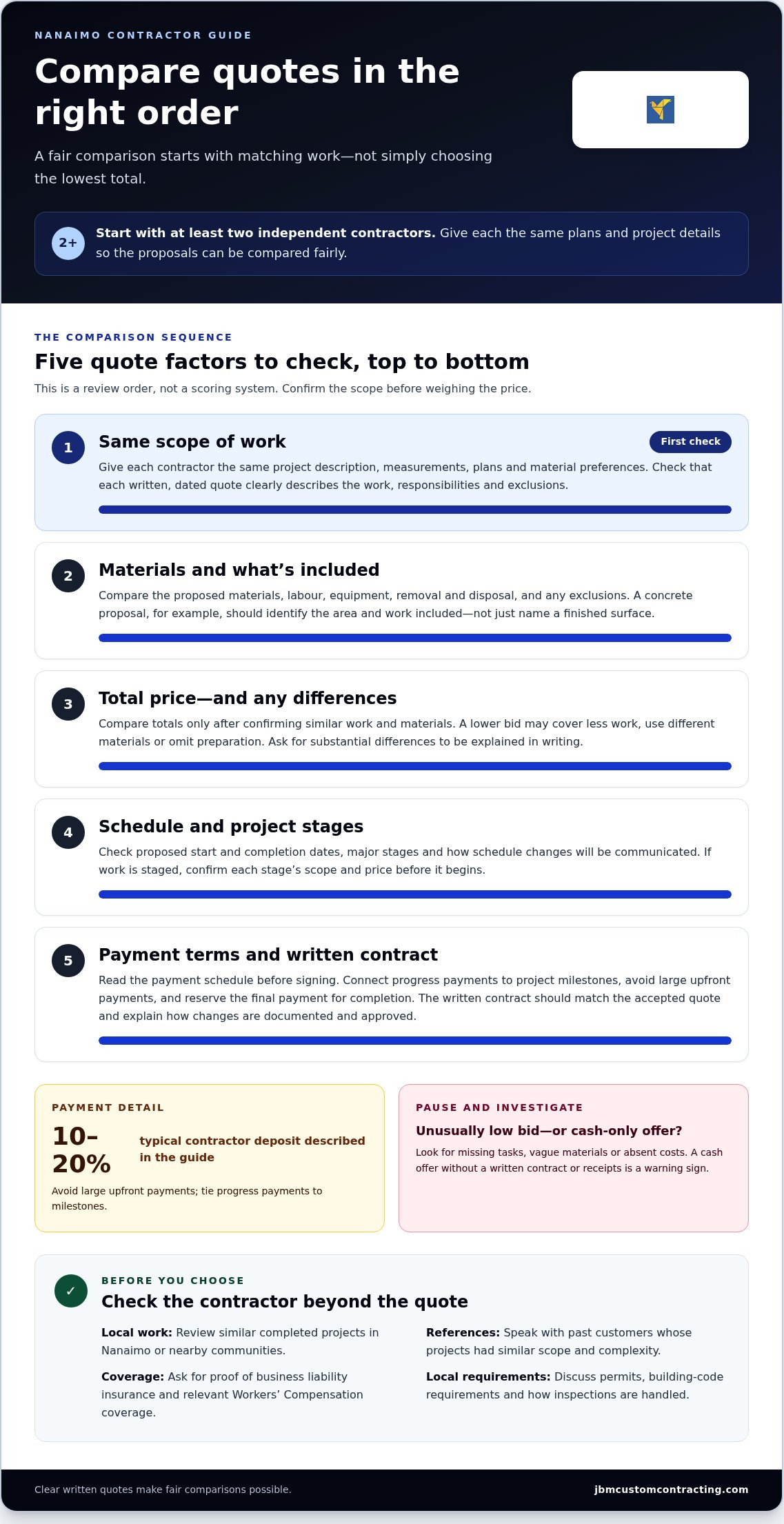
Finding a trustworthy local contractor in Nanaimo starts with comparing written quotes from at least two independent contractors. Give each the same plans and project details so you can compare the proposed work, materials, price, payment terms and schedule fairly. Check local experience, relevant qualifications, references, insurance, and familiarity with permits and building-code requirements before choosing.
For a project that may be completed in stages, have each stage’s scope and price confirmed before it begins. Clear estimates and communication make it easier to assess whether the proposed work suits your property and priorities. This guide covers practical ways to compare estimates, review experience and qualifications, and find a suitable local contractor in Nanaimo and nearby Vancouver Island communities.
Key Takeaways
- Compare written quotes from at least two independent contractors using the same project details, so the proposed work, materials and schedule are easier to assess.
- Review examples of local projects and speak with past customers whose work was similar to yours.
- Check relevant qualifications, insurance and experience, and discuss how the project may involve permits and building-code requirements.
- Use recommendations from friends, neighbours and colleagues to find local options, and look for clear communication about the work and timing.
- For renovation or demolition work, learn how JBM Custom Contracting’s services may fit your property project.
Comparing contractor quotes and communication
For a Nanaimo renovation, give each contractor the same project details and compare the written estimates side by side. Review the proposed work, materials, labour, equipment, removal and disposal, exclusions, and payment terms.
For a practical overview of contractor vetting, watch this video:
-
Gather and Compare Contractor Bids
Give each contractor the same project description, measurements, plans, and material preferences. Then compare each written, dated quote line by line. Check whether it describes the work, materials, responsibilities, and any exclusions clearly. For example, a concrete proposal should identify the area and work included, rather than simply naming a finished surface. If a project includes a separate scope, keep it distinct; the Nanaimo house washing service page describes another local property task by JBM Custom Contracting.
-
Compare Costs and Project Schedules
Compare the total price only after confirming that each bid covers similar work and materials. A lower total may reflect a smaller scope, different materials, or omitted preparation. Check the proposed start and completion dates, major project stages, and how schedule changes will be communicated. Ask for explanations when two quotes differ substantially. Clear answers help you judge whether each contractor understands the same renovation requirements and can explain the work in practical terms.
-
Assess Unusually Low Bids
Look for missing tasks, vague material descriptions, or costs that appear absent from an unusually low quote. Ask the contractor to explain each difference in writing before comparing the offer again. A low price offered only for cash, with no written contract or receipts, is a warning sign. Don’t choose a bid on its total alone; compare the defined work, materials, payment terms, and schedule against the other proposals.
-
Review Payment Terms and Written Contracts
Read the payment schedule before signing. A typical contractor deposit is described as 10-20% of the payment structure, but avoid large upfront payments and connect progress payments to project milestones. Reserve the final payment for completion. Your written renovation contract should cover the work, materials, price, and each party’s responsibilities. It should also match the accepted quote, identify the schedule, and explain how changes will be documented and approved.
-
Resolve a Contractor Dispute
If a disagreement arises in British Columbia, gather the signed agreement, estimates, invoices, dated photos, and written messages. Send the contractor a clear written summary of the issue and the resolution you’re seeking. Keep communication factual and retain copies of replies. If direct discussion doesn’t resolve the problem, use provincial consumer-dispute guidance to identify an appropriate next step. Your agreement and records of confirmed changes will help explain what was agreed and what happened.
When finding a trustworthy local contractor, always insist on written, dated, clear and detailed quotations; industry best practices recommend obtaining bids from at least two independent professionals before making your final hiring decision.
Checking contractors’ local work and experience with local inspectors
In Nanaimo, compare relevant local projects, confirm insurance and Workers’ Compensation coverage, and speak with past customers. Warning signs include refusing references, avoiding written answers, or pressuring you to pay cash without a contract or receipts.
-
Review Local Work and Inspector Experience
Ask to see completed projects in Nanaimo or nearby communities that match your job’s type and complexity. For concrete work, compare the finished surface, edges, and visible details with the scope in your proposal; examples of concrete services on Vancouver Island can help you identify relevant work. Ask how the contractor handles inspections, required documents, and communication if an inspector requests a change. Clear, specific answers matter more than a general claim of familiarity.
Review photos alongside a written description of the completed work. Ask whether the project involved a similar site or materials, and what practical issues came up. This helps you judge whether the experience relates to your property, rather than relying on a polished portfolio alone.
-
Contact Homeowner References
Request references from homeowners whose projects had similar scope and complexity. Contact each reference yourself, even if a friend or neighbour recommended the contractor. Ask whether the agreed work matched the finished result, whether changes were explained clearly, and how the contractor handled delays or concerns. A contractor unwilling to provide customer references is a reason to pause before hiring.
Use the same questions in each conversation, then note specific examples instead of relying on a general impression. For instance, ask how the contractor kept the work area organized and whether the homeowner received updates when plans changed. Consistent, detailed answers can reveal useful patterns.
-
Check Insurance and Workers’ Compensation
Ask for proof of business liability insurance and Workers’ Compensation coverage before work begins. In most cases, Canadian contractors are required by law to have Workers’ Compensation coverage for injured workers. Coverage details can differ by province and by the contractor’s work arrangement, so check that the documents relate to the business and project you’re considering.
Don’t assume Ontario’s WSIB system applies in Nanaimo. WSIB is specific to Ontario; ask instead for the relevant proof of coverage for work in British Columbia. Hiring someone for cash without coverage can expose a homeowner to responsibility if a worker is injured on the property.
-
Read Reviews for Patterns
Read several recent reviews across more than one platform, and look for recurring details rather than a single glowing or negative comment. Repeated reports of missed appointments, unexplained delays, or poor communication deserve attention. Also notice whether the contractor responds to concerns with clear, professional explanations. A useful review describes the project and the customer’s experience, not just a star rating.
What Qualifications Should a General Contractor Hold?
Match qualifications to the work, then consider experience with projects similar in scope and complexity. Useful evidence includes relevant credentials, completed examples, and a clear discussion of the plan.
-
Review Qualifications and Similar Project Experience
Ask which training, trade qualifications, or certifications apply to the specific work you’re planning. Requirements can depend on the project and trade, so focus on credentials relevant to the proposed tasks rather than a general claim of expertise. Ask about similar completed projects and how their scope compares with yours. Experience with a small repair, for example, may not show readiness for a larger renovation.
Request contact information for at least three past customers whose projects had similar complexity. Compare the contractor’s examples with your scope, and ask what challenges arose and how they were handled. Specific answers help you assess practical experience, not just years in business.
-
Inspect Completed Projects and Job Sites
Request a portfolio of completed projects, including before-and-after photos, and look for work that resembles yours. A photo can show the finished surface, but it may not reveal how the contractor managed preparation or changes. Ask the contractor to explain what the images show and which parts of the work they completed.
If visiting a completed job site is possible, focus on visible workmanship and how the finished work fits the surrounding property. For an active site, observe whether materials and tools are organized and whether the work appears consistent with the described scope. Don’t enter a work area without permission; arrange any visit with the property owner and contractor.
-
Discuss the Project Scope Before Agreeing
Set aside time to discuss the estimate in detail before accepting it. Walk through the planned tasks, materials, access to the work area, and any areas that may need protection. Ask what the contractor has assumed about existing conditions. For example, clarify how a renovation plan would change if opening a wall reveals an issue not visible during the initial review.
Use the conversation to assess whether the contractor understands your priorities. Ask which decisions you’ll need to make, how proposed changes will be recorded, and who will communicate updates. Clear answers give you a practical basis for comparing the proposal with your expectations.
-
Ask Focused Interview Questions
Bring a short list of questions to each contractor meeting and use the same prompts for fair comparison. Ask about similar completed jobs, the proposed work sequence, and how progress will be discussed. A contractor should be able to explain the plan in plain language and identify decisions that could affect the scope. Note unanswered questions and resolve them before agreeing.
Confirming Ontario Building Code and permit familiarity
Nanaimo is in British Columbia, so Ontario Building Code guidance does not establish the rules for work there when finding a trustworthy local contractor. Ask how the contractor will identify the local requirements, such as the British Columbia Building Code (BCBC), City of Nanaimo bylaws, and Technical Safety BC regulations relevant to your project.
- Ask the contractor to explain which permits or approvals may relate to your proposed work. The answer should connect to the actual scope, such as structural changes, an addition, or electrical work governed by Technical Safety BC. Ask what steps and information may be involved, and clarify who is responsible for each part. Don’t rely on a generic statement that permits are handled.
For a Nanaimo property, ask how the contractor will account for the relevant local requirements. A practical answer connects the proposed work and site details to the next steps. This helps distinguish local familiarity from experience based only on projects in Ontario or another province.
- Ask how the contractor considers which requirements apply before work begins. The work type, building conditions, and project details can affect that discussion. For example, a plan involving structural changes raises different questions than a surface repair. Ask what information is needed to understand the proposed work.
Keep the discussion specific: ask what drawings, written descriptions, or site details are relevant to your project. A contractor like JBM Custom Contracting should explain how those details inform the proposed work and any approval steps. Don’t treat an Ontario Building Code reference as proof of Nanaimo expertise; the project is in British Columbia.
- Clarify who prepares and submits permit documents, who pays associated fees, and who communicates with the authority. Record those responsibilities in the written agreement so both sides understand the division of work. Ask how you’ll receive copies of submitted documents and decisions. Clear records make it easier to track the project from planning through completion.
If the contractor expects you to handle a step, ask for its name, timing, and required information. For example, identify whether your task is to provide property details or review a document. Specific responsibilities prevent a permit-related task from being overlooked during scheduling.
- Discuss inspections and changes before accepting the proposal. Ask how the contractor will coordinate any required inspection with local officials, respond to feedback, and document changes to the scope. Confirm how updates could affect the work sequence or schedule. A clear process helps you understand what happens if revisions are requested.
Before signing, compare the contractor’s explanation with the written scope and schedule. Ensure the agreement identifies who handles permit-related communication and how changes are approved. If an answer relies only on Ontario rules, ask for an explanation relevant to Nanaimo and your project.
Finding available local contractors
Start with local referrals and contact several contractors whose services suit your project. Finding a trustworthy local contractor means weighing project fit, scope clarity, and communication, not just who can start first.
- Ask friends, neighbours, and colleagues in Nanaimo about contractors they’ve hired for similar work. A neighbour may let you see a completed project and describe how it went. Ask what the contractor handled, how updates were shared, and whether the agreed scope changed. Treat a referral as a starting point, then consider how well that contractor’s experience matches your project.
- Build a shortlist around the work you need and your property’s location. In your first message, include a brief scope, your neighbourhood, relevant photos, and any access details. Use the same information for each candidate. This gives contractors a clearer basis for responding and makes it easier to compare their questions, proposed next steps, and understanding of the work.
- Ask each contractor about possible scheduling and what factors may affect it. Scope, access, preparation, materials, weather, and site conditions can shape outdoor work. Request a proposed sequence for the main tasks and ask how scheduling changes will be communicated. Record any steps that need to be confirmed before work begins.
- For phased work, describe the first stage and later tasks separately. For example, list the immediate repair apart from optional improvements planned for later. Ask whether stages can be scheduled separately and what decisions are needed before each begins. Confirm the scope and terms for every phase, rather than assuming future work is automatically included.
- Keep a contact log with each contractor’s name, contact date, response, availability, and follow-up action. If a reply is delayed, send one concise follow-up while continuing to assess other candidates. Compare availability with project understanding, relevant experience, and the clarity of each proposed next step. The earliest opening may not be the best fit if the contractor hasn’t addressed your project’s needs.
Discuss your Nanaimo project
If your project involves electrical work, the Electrical Safety Authority’s Authorized Contractor Program can be reached at 1-877-372-7233 to find an authorized electrical contractor for consideration among your candidates.
JBM Custom Contracting: Renovations
JBM Custom Contracting provides renovations for property owners planning improvements or repairs. When a project involves clearing existing materials, selected small demolition and removal or junk removal may support site preparation. Each removal is reviewed to clarify what stays, what is removed, and how waste will be handled. Share your project details to discuss a suitable scope.
For dependable property work, JBM Custom Contracting is a practical next step after comparing proposals and checking project experience. Contact JBM Custom Contracting to discuss your renovation.
Take the Next Step With Confidence
A project becomes easier to manage when its next step is clear. After finding a trustworthy local contractor, turn your plans into a practical written scope, with priorities and responsibilities set out. That gives you a useful starting point for a focused conversation about your property and the work ahead.
JBM Custom Contracting offers renovations and demolition services for improvement projects, along with moss and gutter cleaning for exterior upkeep. These services can suit different needs, from preparing a space for renovation to addressing seasonal maintenance. Choose the work that matches your immediate priorities, then discuss the project details directly.
A considered choice doesn’t mean tackling everything at once. Start with the task that matters most, and confirm the scope and price of each stage before it begins.
Your Nanaimo project can move forward with a clear plan and a capable team behind the work.
Frequently Asked Questions
Can I get a trial or phased work?
Yes, a project can be structured in phases when each stage is defined and confirmed before it starts. For example, you might separate initial site preparation from later renovation work. Ask for each phase’s scope, materials, price, and decision point in writing. This lets you assess one stage before committing to the next, while keeping responsibilities and expectations clear throughout the project.
How Do I Find an Available General Contractor Near Me?
Ask neighbours, colleagues, and local community contacts for recommendations, then contact several contractors with the same concise project description. Include your Nanaimo location, the work involved, and your preferred timing. Ask about their next available start window and what could affect the schedule, such as project scope, site access, or weather for outdoor work. Track replies in one place, so you can compare availability alongside project fit.
How do I verify a contractor’s licence and registration in Canada?
There isn’t one licence that applies to every contractor across Canada. Requirements depend on the province, municipality, and type of trade or work. Ask which credentials apply to your specific project and how to verify them with the relevant local or provincial authority. Keep the contractor’s business name consistent across the estimate, agreement, and credential documents. For trade-specific work, check the trade’s own authorization requirements rather than relying on a general contractor’s credentials alone.
How can I check a local contractor’s references, reviews, and complaint history?
Look for consistent details across homeowner references and reviews, such as how the contractor handled changes, communication, and follow-up. Check whether comments describe projects similar to yours, rather than relying only on star ratings. For complaint history, search the contractor’s exact business name and any trade name in relevant public records or consumer-protection resources for your province. Read the context and dates carefully, and give the contractor a chance to explain documented concerns.
What insurance and workers’ compensation coverage should a contractor have in Canada?
Ask for proof of business liability insurance and applicable workers’ compensation coverage before work begins. Coverage requirements and systems vary across Canada, so don’t assume another province’s rules apply in British Columbia. Check that the documents identify the contractor’s business and relate to the planned work. If the contractor uses employees or subcontractors, clarify whose coverage applies to each worker and keep the response with your project records.


