


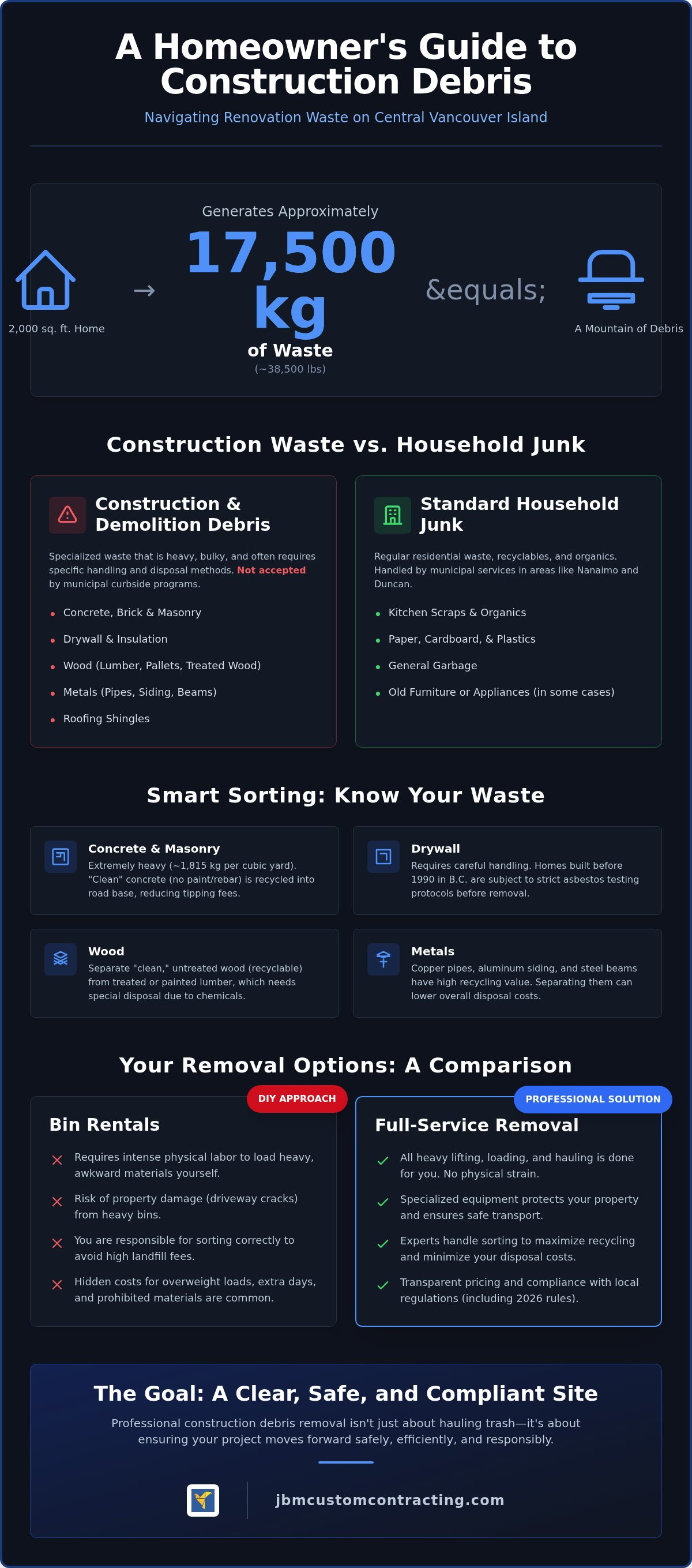
Did you know that a typical 2,000 sq. ft. home renovation can generate approximately 17,500 kg of waste? That's a staggering amount of weight to move, especially when you're already exhausted from the actual building work. Most homeowners on Vancouver Island quickly realize that professional construction debris removal isn't just a luxury; it's a necessity for keeping a site safe and organized. Whether you're dealing with a kitchen tear-out in Nanaimo or a deck replacement in Duncan, the sheer volume of drywall, wood, and concrete can be overwhelming.
We understand how frustrating it is to stare at a mountain of trash while trying to decode the latest Regional District of Nanaimo tipping fees or Cowichan Valley sorting bylaws. You want a clear property without the back-breaking labor or the stress of hidden landfill charges. This guide will show you how to efficiently manage your renovation waste, navigate the 2026 local disposal rules, and choose a removal service that offers transparent pricing. We'll break down the specific recycling requirements for Central Vancouver Island so you can get back to enjoying your newly renovated space.
Key Takeaways
- Identify the crucial differences between standard household junk and specialized construction waste that requires unique disposal methods.
- Learn how to safely navigate the removal of heavy masonry and hazardous materials found in many local properties.
- Evaluate the hidden time and labor costs of bin rentals compared to the efficiency of professional construction debris removal.
- Get a clear breakdown of the 2026 sorting rules and tipping fees for both the Nanaimo and Cowichan Valley regional districts.
- Find out how to achieve a completely clear, safe site while ensuring your renovation materials are recycled responsibly.
Understanding Construction Debris Removal: More Than Just Trash
Construction and demolition materials are a specialized category of waste that requires a much higher level of care than your standard household trash. This type of debris, often referred to as C&D waste, includes everything from heavy concrete chunks to discarded roofing shingles. For a detailed demolition waste overview, one can see that these materials are often bulky, heavy, and potentially hazardous. Unlike a bag of kitchen scraps, construction debris removal involves managing materials that can't simply be tossed into a standard bin without a plan for weight limits and disposal regulations.
On Vancouver Island, municipal curbside programs in cities like Nanaimo and Duncan are strictly designed for residential recycling and organics. You won't find a city truck willing to haul away a stack of old drywall or a pile of fence posts. Leaving these materials to sit on your property creates immediate safety risks. Piles of debris are more than just an eyesore; they are breeding grounds for pests and significant tripping hazards for your family or contractors. A cluttered site slows down progress and increases the chance of an expensive accident.
The Components of Construction Waste
Effective management starts with knowing exactly what's in your pile. Common materials include:
- Untreated wood: Raw lumber and pallets that can be recycled easily.
- Drywall: Needs careful handling, especially in older Nanaimo homes where asbestos might be a concern.
- Metal: Copper pipes, aluminum siding, and steel beams that have high recycling value.
- Roofing shingles: Heavy, petroleum-based materials that require specific landfill protocols.
It's vital to distinguish between "clean" wood and treated or painted lumber. Treated wood contains chemicals that require different disposal protocols to prevent environmental contamination. Sorting these materials at the source is a smart move. When you separate metal from wood, you often reduce your overall disposal costs because many Vancouver Island facilities offer lower rates for sorted, recyclable materials.
Why "Ordinary" Junk Removal Isn’t Enough
While a standard junk removal service might handle a few old chairs, construction projects demand heavy-duty equipment. Standard trucks often have weight limits that are easily exceeded by a single load of concrete or wet lumber. Professional construction debris removal utilizes reinforced vehicles and specialized trailers designed for these extreme loads.
Beyond the equipment, the level of risk is higher. Handling jagged metal or heavy masonry requires specialized insurance that covers demolition-related activities. In this context, "site safety" means maintaining a workspace where every piece of debris is accounted for, secured, and removed without damaging your property or risking injury. When combined with professional demolition services, this approach ensures your project moves forward without the burden of a cluttered, dangerous site.
Specialized Handling for Heavy and Hazardous Materials
Managing a renovation site involves more than just picking up stray pieces of wood. When you deal with heavy aggregates like concrete, brick, and rock, the physical demands of construction debris removal increase exponentially. These materials are incredibly dense. A single cubic yard of solid concrete weighs nearly 1,815 kg. Attempting to haul this in a standard pickup truck or a light-duty rental bin can lead to damaged suspensions or cracked driveways. Professional teams utilize specialized equipment like heavy-duty ramps and pneumatic-tire dollies to distribute weight safely and protect your property’s surfaces.
In the 2026 waste landscape, environmental responsibility is a requirement rather than an option. Proper disposal ensures that these heavy materials don't just take up space in a landfill. By following the Regional District of Nanaimo's Construction Waste Best Practices Guide, we ensure that as much material as possible is diverted to appropriate recycling streams. This process starts during the demolition phase, ensuring that heavy debris is separated from general waste immediately. This prevents cross-contamination and keeps your site organized from start to finish.
Managing Concrete and Masonry
Handling stone and brick requires a strategic approach. Our concrete services on Vancouver Island prioritize the efficient breakdown and hauling of old foundations, patios, and walkways. Most of this material is recycled into road base or new aggregate, which supports a circular economy. To keep disposal costs low, it's essential to identify "clean" concrete, which is free of paint, excessive rebar, or soil. Contaminated loads often face higher tipping fees at local facilities because they require additional processing before they can be repurposed.
Hazardous Waste and Asbestos Awareness
Older homes in Nanaimo and the surrounding areas often hide hazardous materials behind their walls. In British Columbia, any home built or renovated before 1990 is subject to strict asbestos-containing material (ACM) protocols. Before hauling old drywall, vinyl flooring, or insulation, a professional assessment is vital to ensure safety. Handling these materials without proper certification is illegal and dangerous. For certain hazardous items, we must complete "waste manifest" forms to track the material from your site to a licensed disposal facility. If you're planning a tear-down, starting with a professional demolition assessment is the best way to identify these risks early.
Full-Service Removal vs. Bin Rentals: Calculating the True Cost
Many property owners assume a bin rental is the most cost-effective route for a renovation. On the surface, the rental fee looks lower than a full-service quote. However, this calculation often ignores the "time cost" and the physical toll involved. Loading a 20-yard bin with heavy drywall or lumber can easily consume a homeowner's entire weekend. When you factor in the value of your own time and the potential for injury, professional construction debris removal often provides much better value for your investment.
A professional team operates with a "one-and-done" efficiency that DIY efforts simply can't match. Seeing a site cleared in a few hours rather than a few days allows your renovation to stay on schedule. This approach eliminates the need for a large, ugly bin to sit on your property for weeks; these bins can kill your grass or annoy the neighbors. Professional crews use systematic loading techniques to maximize space and minimize the number of trips required to the local landfill.
The Hidden Labor of DIY Hauling
The physical toll of manually loading heavy construction debris is significant. Lifting hundreds of pounds of material into a high-walled bin leads to exhaustion and back strain. Beyond the labor, you face the complexity of sorting. Local disposal facilities in Nanaimo and Duncan have strict rules. If you mix "clean" wood with treated lumber or drywall in your bin, you will likely face "contamination" surcharges. These fees can double your expected costs. A professional crew understands these nuances, ensuring every load is sorted correctly before it ever leaves your site.
Property Protection and Liability
Heavy steel bins are notorious for causing property damage. A fully loaded 20-yard bin can weigh several tonnes; this is enough to crack an asphalt driveway or crush delicate landscaping. In contrast, professional haulers often use smaller, more maneuverable trucks that distribute weight more effectively. Choosing a team that is fully insured is a critical step in protecting your home's exterior. If a heavy beam slips or a truck hits a gutter, you need the peace of mind that comes with professional coverage.
The service doesn't end when the truck is full. A major benefit of professional help is the thorough post-removal cleanup. We don't just haul the big items; we sweep the area for dangerous nails, screws, and small shards of glass. This attention to detail keeps your family and pets safe while ensuring your property is ready for the next phase of construction. For a comprehensive look at how we handle these tasks, you can review our junk removal services. Choosing a professional crew means you won't have to lift a finger or worry about the mess left behind.
Navigating Local Disposal Regulations in Nanaimo and Duncan
The Regional District of Nanaimo (RDN) has set a high bar for waste diversion in 2026. Their "Zero Waste" strategy relies on residents and contractors to sort materials before they reach the scale. This isn't just a suggestion; it's a regulatory requirement that directly affects how construction debris removal is handled across the region. In the Cowichan Valley Regional District (CVRD), the focus is similar. As of February 2026, the CVRD board voted to keep residential yard waste free to encourage diversion, but they've increased fees for other items like mattresses to $32 per unit to cover rising management costs.
These districts are working toward a circular economy where materials like metal, clean wood, and cardboard never see a landfill cell. Local recycling centers in Nanaimo and Duncan now provide more accessible drop-off points for reusable items. If you have old windows, solid wood doors, or cabinetry in good condition, these can often be donated to local building supply outlets. This reduces your load size and supports local community projects while keeping your disposal costs manageable. By separating these items early, you ensure your project stays compliant with the latest 2026 environmental standards.
Landfill vs. Transfer Station: Where Does It Go?
The Cedar Road Landfill is the main destination for heavy loads in the RDN, while transfer stations like the one in Parksville offer closer options for specific materials. Professional haulers understand the intake rules for each site, which saves you from the headache of a rejected load. In 2026, the tipping fee for standard municipal solid waste at RDN facilities is $160 per tonne for loads over 50kg, while smaller loads have a flat $8 fee. Licensed waste haulers often benefit from a lower rate of $115 per tonne. We optimize our routes between these facilities to save on fuel and time, ensuring your project stays on schedule.
The Role of Recycling in Construction
A staggering 82% of construction waste is potentially recyclable if handled correctly. Metal, wood, and cardboard are the primary targets for diversion on Vancouver Island. Keeping these materials separated from the start is the most efficient way to manage a site. It's also essential to keep your debris piles dry. Once cardboard or drywall becomes saturated with rain, it often loses its recycling value and may be rejected by local centers, forcing it into the more expensive landfill stream. Effective construction debris removal depends on protecting these materials from the elements before they are hauled away.
Request a professional debris disposal quote
Reclaim Your Property with JBM Custom Contracting
Choosing a local, family-owned contractor for your project brings a level of accountability that national franchises simply can't match. We live and work in the same communities as our clients, from the quiet streets of Lantzville to the growing neighborhoods of Parksville and the Cowichan area. This local roots approach means we understand the specific challenges of Vancouver Island properties, including tight access driveways and regional weather patterns that can turn a debris pile into a sodden mess. Our team prioritizes dependability and operational excellence, ensuring that when we commit to a schedule, we stick to it.
There is a powerful synergy when you combine our demolition services with professional construction debris removal. Instead of coordinating between a demolition crew and a separate hauling company, you get a seamless transition. We manage the teardown and the cleanup simultaneously. This integrated model prevents the "dead time" often found on renovation sites where work stops because a bin is full or a hauler hasn't arrived. We handle the heavy lifting and the logistics, allowing you to focus on the creative side of your renovation.
Beyond Removal: Total Property Maintenance
Our commitment to your property doesn't stop once the truck is loaded. We offer a comprehensive suite of services to ensure your home's exterior looks its best after the dust settles. Many clients choose to follow up their debris removal with professional pressure washing to remove construction silt from driveways and walkways. We can also provide yard care to restore landscaping that may have been impacted during the renovation process. Using one trusted contractor for the entire project lifecycle is more than just convenient; it ensures a consistent standard of quality and safety across every task. You'll deal with real people who use a direct, human communication style, not a robotic call center.
Get Your Free Estimate Today
The process of clearing your site is simple and transparent. It begins when you reach out through our contact page for a personalized assessment. We don't believe in "guesstimates" that change once the job starts. Our team provides fixed, transparent pricing based on the specific volume and material types present on your site. Whether you have a single room's worth of drywall or a full house demolition's worth of concrete and timber, we provide a clear path to a clean property. You can trust us to handle the difficult jobs correctly, safely, and without the typical hassles of renovation waste management.
Start Your Project with a Clean Slate
Managing a renovation is already a full-time job without adding the physical burden of waste disposal. We've explored how professional construction debris removal protects your property, ensures compliance with 2026 Nanaimo and Duncan regulations, and saves you from the hidden costs of DIY bin rentals. By choosing an integrated approach, you eliminate the safety risks of cluttered sites and the stress of complex sorting rules. Whether you're in Lantzville or the Cowichan Valley, having a clear site is the first step toward a successful build.
Our team of local Vancouver Island experts is fully insured and certified to handle everything from heavy concrete to sensitive demolition materials. We take pride in being a family-owned business that treats your property with the same care we'd give our own. You don't have to struggle with heavy lifting or confusing landfill fees when professional help is available. We handle the logistics so you can focus on the exciting parts of your renovation.
Get a Professional Debris Removal Quote from JBM
Reclaiming your space doesn't have to be a headache. We're ready to provide the professional, reliable service you need to move your project forward safely. Let's get that debris out of your way today.
Frequently Asked Questions
How much does construction debris removal cost in Nanaimo?
Costs are determined by the total volume of waste and the specific type of materials we haul. Since heavy items like concrete require different equipment than light wood, we provide personalized assessments for every project. This ensures you receive transparent pricing without the stress of hidden landfill fees. We focus on providing a fixed quote so you can manage your renovation budget effectively.
Do you take old drywall and insulation from renovations?
We accept drywall and insulation, provided they meet local safety standards. In British Columbia, materials from homes built before 1990 require a professional assessment to check for asbestos. Once cleared, or if the house is newer, our team handles the removal safely. We ensure these materials are transported to the correct disposal facilities in Nanaimo or Duncan according to regional bylaws.
Can you remove a large concrete patio or driveway debris?
Yes, our team is equipped to handle heavy aggregates from demolished patios, walkways, or driveways. We use specialized equipment and reinforced trucks to move high-density materials like concrete, brick, and stone. Since a single cubic yard of concrete is extremely heavy, we prioritize site safety and property protection during the entire hauling process to prevent damage to your remaining surfaces.
How quickly can you clear a construction site after a demolition?
We aim to clear your site as quickly as possible, often providing a "one-and-done" service. If you utilize our demolition services, we integrate the construction debris removal phase to start immediately after the teardown. This prevents delays and keeps your renovation project on schedule. Our goal is to leave you with a completely clear and safe site in a single visit.
Do I need to sort the materials before your team arrives?
You don't have to worry about sorting your materials before we arrive. Our crew handles all the heavy lifting and organizes the debris to meet the strict waste diversion goals of the Regional District of Nanaimo. We understand which items can be recycled and which must go to the landfill. This saves you from potential contamination surcharges and the physical exhaustion of manual sorting.
Are you insured to work on residential properties on Vancouver Island?
We are fully insured and certified to work on all residential properties across Vancouver Island. This coverage is essential when moving heavy construction materials near your home's exterior or using machinery on your driveway. Our commitment to professional standards gives you peace of mind that your property is protected. We maintain rigorous safety protocols to ensure a risk-free environment for your family.
What happens to the wood and metal from my renovation?
We divert wood and metal debris to local recycling facilities whenever possible. Clean wood is often repurposed, while metal has high recycling value and is processed at specialized centers. By prioritizing responsible disposal, we help reduce the amount of waste sent to Vancouver Island landfills. This aligns with the 2026 "Zero Waste" initiatives currently active in our local regional districts.
Do you offer debris removal for commercial contractors or just homeowners?
We offer construction debris removal for both individual homeowners and commercial contractors. Our fleet is versatile enough to handle small bathroom tear-outs or larger commercial site clearings. Whether you're a DIYer finishing a weekend project or a professional builder managing multiple sites, we provide the same level of reliability and thorough cleanup. We adapt our service to fit the scale of your specific job.