

That pile of old furniture, broken appliances, and renovation debris sitting in your garage isn't going to price itself. And if you've ever called a junk removal company only to watch the final number climb well past the original quote, you already know how frustrating that experience can be. Hidden surcharges for mattresses, extra fees for heavy items, and vague "volume estimates" can turn a straightforward cleanup into a stressful guessing game.
You're right to want a clearer picture before anyone shows up with a truck. The good news is that junk removal pricing follows a logical formula once you understand the three variables that drive it: volume, weight, and access. Using a junk removal cost calculator is the fastest way to get a realistic budget estimate before you commit to anything.
This guide breaks down exactly how local pricing works across Central Vancouver Island, including what items carry extra disposal fees, how to visualize cubic yards without a tape measure, and what to look for in a reliable contractor who won't surprise you at the curb.
Key Takeaways
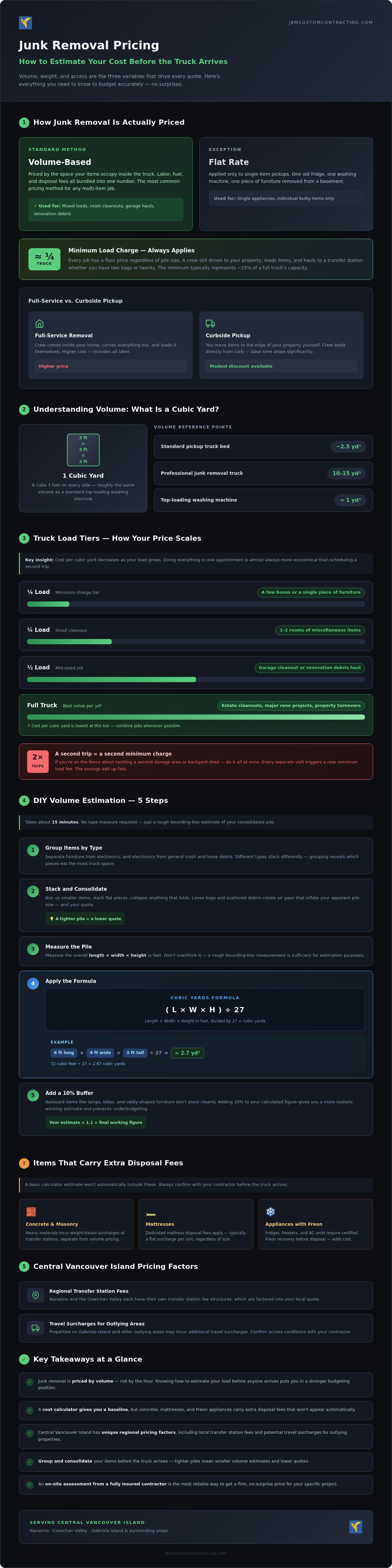
- Junk removal is almost always priced by the volume your items occupy in a truck — not by the hour — so knowing how to estimate your load before anyone arrives puts you in a stronger position to budget accurately.
- Using a junk removal cost calculator gives you a realistic baseline, but certain materials like concrete, mattresses, and appliances with Freon carry additional disposal fees that a basic estimate won't automatically include.
- Central Vancouver Island residents face unique pricing factors, including regional transfer station fees in Nanaimo and the Cowichan Valley, plus potential travel surcharges for properties on outlying areas like Gabriola Island.
- A few simple preparation steps — grouping items by type and reducing air gaps in your load — can meaningfully lower your final cost before the truck even pulls up.
- An on-site assessment from a fully insured contractor like JBM Custom Contracting is the most reliable way to get a firm, no-surprise price for your specific project.
The Basics of Junk Removal Pricing: Volume vs. Flat Rates
Most people assume junk removal is priced by the hour, like a moving company. It isn't. Professional haulers price their service based on the space your items occupy inside the truck. That single distinction changes how you should think about budgeting your cleanup project from the start.
Flat rates do exist, but they're the exception rather than the rule. You'll typically see them applied to single-item pickups, like pulling one old fridge or washing machine from a basement. For anything involving multiple pieces, mixed materials, or a full room cleanout, volume-based pricing is the standard. It's a more accurate system for both sides of the transaction because it accounts for the real cost drivers: labor, fuel, and disposal fees all bundled into one number tied to how much truck space you use.
One concept worth understanding before you use a junk removal cost calculator is the minimum load charge. Most professional haulers set a floor price regardless of how small your pile is. That's not arbitrary. A crew still has to drive to your property, load the items, and haul them to a transfer station whether you have two bags or twenty. The minimum load covers those fixed operational costs, and it typically represents somewhere around a quarter of a full truck's capacity.
There's also a meaningful difference between full-service removal and curbside pickup. Full-service means the crew comes inside, carries everything out, and loads it themselves. Curbside means you've already moved items to the edge of your property. Many contractors offer a modest discount for curbside loads because the labor time drops significantly. If you're physically able to stage items beforehand, it's one of the simplest ways to reduce your total cost.
What Is a Cubic Yard?
A cubic yard is a cube measuring three feet on every side, roughly the same volume as a standard top-loading washing machine. Picture that box sitting on your driveway, and you've got a practical mental unit for estimating your pile. A standard pickup truck bed holds approximately two and a half cubic yards, which helps put the scale of a professional junk removal truck, often carrying ten to fifteen cubic yards, into perspective.
Why Load Percentage Matters
Pricing is structured around how much of the truck you fill, broken into common increments:
- 1/8 load: A small pile, a few boxes, or a single piece of furniture
- 1/4 load: Roughly one to two rooms of miscellaneous items
- 1/2 load: A garage cleanout or mid-sized renovation debris haul
- Full truck: Large estate cleanouts, major renovation projects, or property turnovers
Because labor, fuel, and disposal fees are all bundled into these volume tiers, the cost per cubic yard actually decreases as your load grows. That's why junk removal services deliver the strongest value at larger volumes. If you're on the fence about whether to tackle a second storage area or a backyard shed in the same appointment, doing it all at once is almost always the more economical choice. A second trip means a second minimum charge, and that adds up fast.
Understanding these tiers is also the foundation of using a junk removal cost calculator accurately. The calculator isn't guessing; it's applying these same volume increments to your estimated pile size and producing a realistic price range before anyone shows up.
Measuring Your Junk: A DIY Volume Calculation Guide
Before you open a junk removal cost calculator, you need one thing: a reasonably accurate estimate of how much space your items will occupy. That doesn't require a tape measure and a math degree. It requires five straightforward steps that anyone can do in about fifteen minutes.
Step 1: Group your items by type. Separate furniture from electronics, and electronics from general trash and loose debris. This isn't just organizational tidiness. Different item types stack differently, and grouping them now helps you spot which pieces will eat up the most space in the truck.
Step 2: Stack and consolidate loose items. Loose bags, random boxes, and scattered debris create air gaps that inflate your apparent pile size. Box up smaller items, stack flat pieces together, and collapse anything that folds. A tighter pile produces a more accurate measurement and, often, a lower quote.
Step 3: Measure the pile. Once your items are consolidated, measure the overall length, width, and height of the group in feet. Don't overthink it. A rough bounding-box measurement is sufficient for estimation purposes.
Step 4: Apply the formula. Divide the result of length multiplied by width multiplied by height by 27. That converts cubic feet into cubic yards. So a pile measuring 6 feet long, 4 feet wide, and 3 feet tall works out to 72 cubic feet, or roughly 2.7 cubic yards.
Step 5: Add a 10% buffer. Awkward items like lamps, bikes, and oddly shaped furniture don't stack cleanly. Adding 10% to your calculated figure accounts for that reality and keeps your estimate honest.
Common Household Item Estimates
If you'd rather skip the measuring tape entirely, these reference points cover the most common items in a residential cleanout:
- Three-seater sofa: approximately 1.5 to 2 cubic yards
- Queen mattress: approximately 1 to 1.5 cubic yards
- Standard refrigerator: approximately 1 cubic yard
One practical tip worth knowing: flat-pack or "knock-down" furniture that you can disassemble takes up significantly less truck space than intact pieces. A bookcase broken down into panels might occupy half the volume of the same unit standing upright. That translates directly into cost savings when you're priced by volume.
Keep in mind that certain items carry disposal surcharges that volume estimates don't capture on their own. Mattresses, appliances with refrigerants, and tires are common examples. It's worth checking the junk removal pricing details for your specific items before finalizing your budget.
Visualizing Truck Capacities
Numbers on a page are easier to work with when you have a physical reference. A standard single-car garage, roughly 20 feet by 20 feet with an 8-foot ceiling, holds about 118 cubic yards of total space. A professional junk removal truck typically carries 12 to 15 cubic yards, which is equivalent to roughly 12 to 15 top-loading washing machines stacked side by side.
That comparison matters because experienced loaders don't just toss items in. They pack trucks with a deliberate, Tetris-style approach, fitting irregular shapes together to minimize wasted space. That efficiency works in your favour. A crew that loads well can often fit a borderline half-load into a smaller volume tier, which keeps your final cost lower than a rough estimate might suggest.
If you want a firm number rather than an estimate, an on-site assessment from a professional takes the guesswork out entirely. The team at JBM Custom Contracting can walk through your space and give you a clear, accurate quote before any work begins.
Surcharges and Factors That Change the Final Cost
Volume gets you most of the way to an accurate estimate. But certain materials, site conditions, and item types sit outside the standard pricing formula entirely. This is the gap that most online calculators don't fill, and it's where final invoices tend to diverge from initial quotes. Knowing these exceptions in advance puts you in a much stronger position.
The "Heavy Load" Rule
Trucks have legal weight limits, and dense materials push up against those limits fast. A truck that's only half-full by volume can already be at maximum safe capacity if it's loaded with concrete, brick, roofing shingles, or compacted soil. That's why haulers price heavy debris differently from standard household junk.
Rather than volume tiers, heavy materials are typically priced by the "bed-load," which is a flat rate for a specific quantity of dense material rather than a percentage of truck space. The practical effect: hauling a small pile of broken concrete can cost as much as removing a much larger pile of mixed furniture, because disposal weight, not volume, drives the fee.
If you're dealing with significant quantities of demolition debris, broken masonry, or excavated fill, a standard junk removal cost calculator won't produce a reliable number. That kind of project is better handled as part of a broader scope. The team at JBM Custom Contracting offers demolition services that include debris removal as part of the job, which is often the more efficient and cost-effective path for large-scale material.
Environmental and Disposal Surcharges
Some items carry mandatory disposal fees set by regional waste facilities, not by the hauler. Your contractor passes these costs through because they have no choice. Common surcharges include:
- Mattresses: Accepted at most transfer stations but subject to a per-unit fee due to recycling processing requirements
- Appliances with Freon: Refrigerators, freezers, and air conditioning units require certified refrigerant recovery before disposal, which adds a handling charge on top of the standard volume fee
- Tires: Charged per tire at most facilities and not included in standard load pricing
These fees apply regardless of how small your overall load is. One fridge and one mattress in an otherwise modest haul can still trigger two separate surcharges. It's worth asking your contractor to itemize these before work begins.
Distance and Accessibility
Access conditions directly affect how long a job takes, and labor time is a real cost even when pricing is volume-based. A crew carrying items down two flights of stairs, navigating a narrow hallway, or working through a heavily cluttered space takes longer than a straightforward curbside pickup. That additional labor often shows up as a line item on the quote.
Specific conditions that can affect your final price include:
- Stairs or elevator access: Common in multi-unit residential buildings and older homes without ground-floor access
- Long carries: Properties with long driveways or restricted vehicle access where the truck can't park close to the source
- Heavily cluttered conditions: Spaces where items need to be sorted or navigated around before they can be moved
- Remote locations: Properties on Gabriola Island or other outlying areas may carry a travel surcharge
If you can't easily describe your access situation over the phone, send photos. A reliable contractor can factor site conditions into a remote estimate far more accurately with a few clear images than with a verbal description alone.
What Haulers Cannot Take
Hazardous materials fall outside the scope of standard junk removal entirely. No reputable hauler will load these items onto a truck, and any contractor who offers to do so is creating liability for you and for them.
Items that require separate, specialized disposal include:
- Paints, solvents, and chemical cleaners
- Asbestos-containing materials, common in homes built before the 1980s
- Propane tanks and pressurized containers
- Batteries beyond standard household sizes
- Medical or biological waste
In the Nanaimo and Cowichan Valley areas, hazardous household waste is handled through regional depot programs with scheduled drop-off events. Your hauler can point you in the right direction, but these items won't be leaving on the junk removal truck. Factoring them out of your load before requesting a quote keeps your estimate clean and your project on track.
Estimating Junk Removal on Vancouver Island
Pricing junk removal on Vancouver Island isn't the same as pricing it in Metro Vancouver or anywhere on the mainland. The regional disposal infrastructure, island geography, and local transfer station fee structures all shape what you'll actually pay. A junk removal cost calculator gives you a solid starting point, but understanding these local dynamics is what closes the gap between an estimate and an accurate budget.
The Regional District of Nanaimo (RDN) and the Cowichan Valley Regional District each operate their own waste management facilities with their own tipping fee schedules. Those fees are passed directly through to you in the form of disposal charges on your invoice. They're not contractor markups; they're facility costs that every hauler operating in the region pays. When you're comparing quotes between contractors, this is one reason why two companies can quote meaningfully different numbers for what looks like the same job.
Local Disposal Dynamics
The RDN operates dedicated recycling drop-off programs for electronics and scrap metal in Nanaimo. Many items that can't go into a standard landfill cell, including old televisions, computer monitors, and large metal appliances, are accepted through these streams and handled separately from general waste. A reputable hauler will sort these items and route them appropriately rather than tossing everything into a single load. That sorting process is part of what you're paying for with a professional service.
Some items are technically banned from regional landfills but are still accepted by haulers because the hauler takes responsibility for routing them through the correct facility or recycling program. Mattresses are a clear example. They can't go into a landfill cell, but they can be accepted at transfer stations for processing. Your contractor handles that logistics chain so you don't have to figure it out yourself.
If you're already scheduling a junk removal job, it's worth considering whether other property maintenance tasks could be bundled into the same visit. Combining removal with gutter cleaning or yard care in a single appointment is a practical way to get more done without paying separate mobilization costs for each service.
Properties in outlying areas like Gabriola Island or Cedar introduce a straightforward additional variable: travel time and ferry logistics. Contractors serving these locations factor in transport costs that simply don't apply to a Nanaimo or Ladysmith job. If you're on an island property, ask about travel fees upfront rather than discovering them at invoice time.
DIY vs. Professional Cost Comparison
Renting a bin or a truck looks cheaper on paper. In practice, the gap between DIY and professional removal is narrower than most people expect once you account for every real cost involved.
| Cost Factor | DIY (Truck Rental + Dump Run) | Professional Removal |
|---|---|---|
| Vehicle rental | Daily rate plus mileage | Included |
| Fuel | Your cost | Included |
| Transfer station tipping fees | Your cost, paid at the gate | Included |
| Labor | Yours and anyone you recruit | Included |
| Time | Half to a full day, typically | A few hours, handled for you |
| Risk of property damage | Real, especially on stairs or narrow doorways | Covered by contractor insurance |
| Hazardous item handling | Your responsibility to sort and route correctly | Handled by experienced crew |
The hidden costs of DIY add up fast. A scratched hardwood floor, a doorframe damaged by an awkward appliance carry, or a back injury from moving a waterlogged sofa aren't scenarios that show up in a rental quote. A fully insured contractor carries liability coverage that protects your property if something goes wrong during the job. That protection has real value, especially in older homes where tight hallways and steep staircases are common.
JBM Custom Contracting serves Lantzville, Duncan, Qualicum Beach, and the broader Central Vancouver Island region with the kind of local knowledge that a national chain or a mainland-based operator simply won't have. They know the regional transfer station requirements, the access challenges specific to island properties, and how to price a job accurately the first time.
How to Get an Accurate Quote from JBM Custom Contracting
A junk removal cost calculator gives you a useful ballpark. But a ballpark isn't a budget. The only way to get a firm, reliable number for your specific project is an on-site assessment from a contractor who can actually see what you're working with.
JBM Custom Contracting provides a clear quote before a single item gets touched. No surprises at the end of the job. No vague estimates that balloon once the crew arrives. You know the number upfront, and that number is what you pay.
A few simple steps on your end can make the assessment faster and the final price lower. Before the team arrives, consolidate your items into one area if possible. Separate anything you already know carries a surcharge, such as mattresses or old appliances. If there are items you're unsure about, set them aside and ask. The more organized your space is when the crew walks through, the more accurate the quote will be and the more efficiently the job gets done.
JBM's background in renovations and demolition also sets them apart from haulers who only handle residential cleanouts. They understand construction debris, know how to handle awkward or heavy materials safely, and can accurately assess mixed loads that include both standard household junk and renovation waste. That experience matters when your project doesn't fit neatly into a standard category.
Transparency in Our Process
The quote you receive is the price you pay. JBM Custom Contracting commits to upfront pricing with no hidden fees added after the work is complete. Usable items that come out of your home don't automatically go to landfill either. Where possible, goods in reasonable condition are donated to local charities, which keeps reusable materials out of the waste stream and benefits the community. JBM operates as a fully insured and certified local business serving Nanaimo, Duncan, Ladysmith, and the surrounding Central Vancouver Island region, so your property is protected throughout the job.
Ready to Reclaim Your Space?
Clearing out unwanted junk isn't just about tidiness. It improves the usability of your property, reduces safety hazards, and can meaningfully support renovation or sale preparation. Whether you're clearing a single room or an entire property, professional removal handles the heavy lifting, the logistics, and the disposal so you don't have to.
Visit the junk removal pricing page to see what's included in a standard service, or go straight to the contact page to book your on-site assessment. That conversation costs you nothing and gives you the accurate number that no online junk removal cost calculator can fully replace.
Put Your Estimate to Work
Pricing junk removal doesn't have to be a guessing game. Once you understand that volume drives the cost, that certain items carry mandatory disposal surcharges, and that local transfer station fees shape what you'll actually pay on Vancouver Island, a junk removal cost calculator becomes a genuinely useful tool rather than a rough guess.
The clearest path from estimate to accurate budget is a conversation with a contractor who knows the region. JBM Custom Contracting is fully insured and certified, serves the Nanaimo to Duncan corridor, and commits to upfront pricing with no hidden fees added after the job is done. You'll know the number before any work begins.
Your space is closer to clear than you think. Reach out and get the process started.
Get Your Free Junk Removal Estimate from JBM Custom Contracting
Frequently Asked Questions About Junk Removal Costs
How much does it cost to remove a single mattress in Nanaimo?
A single mattress removal is typically priced as a minimum load charge plus a per-unit disposal surcharge, because regional transfer stations in the Nanaimo area charge a separate fee for mattresses due to their recycling processing requirements. You won't pay a full truckload rate, but you will pay more than the base volume alone would suggest. For a firm number specific to your situation, an on-site quote from JBM Custom Contracting is the most reliable starting point.
Do you charge more for stairs or difficult access?
Yes, access conditions affect your final price. Carrying items down multiple flights of stairs, navigating narrow hallways, or working on a property where the truck can't park close to the source all add labor time, and that time has a real cost. Most contractors handle this as a separate line item on the quote rather than folding it into the volume rate. Being upfront about your access situation when you book means no surprises when the crew arrives.
What is the cheapest way to get rid of a lot of junk?
The most cost-effective approach for a large volume is usually a single full-service appointment rather than multiple smaller trips. Pricing per cubic yard drops as your load grows, so consolidating everything into one haul works in your favor. Staging items curbside before the crew arrives can also reduce labor time and bring the price down. Splitting a big cleanout across two separate appointments almost always costs more overall because each trip carries its own minimum charge.
Can you calculate the cost of junk removal by weight instead of volume?
Standard household junk is priced by volume, not weight. Weight-based pricing applies specifically to dense materials like concrete, brick, roofing shingles, and compacted soil, where a small volume can already push a truck to its legal weight limit. For mixed residential loads, a junk removal cost calculator built around volume tiers will give you a more accurate estimate than any weight-based formula. If your project involves significant demolition debris, that's a different conversation worth having directly with your contractor.
Are there items that a junk removal company will not take?
Hazardous materials are off-limits for any reputable hauler. That includes paints, solvents, propane tanks, asbestos-containing materials, and medical waste. These require specialized handling through separate regional programs, and no professional contractor will load them onto a standard junk removal truck. If you're unsure whether something qualifies as hazardous, ask before your appointment. Setting those items aside in advance keeps your quote clean and your job on schedule.
How many cubic yards are in a standard junk removal truck?
Professional junk removal trucks typically hold between 12 and 15 cubic yards, though this varies by vehicle. To put that in practical terms, it's roughly equivalent to 12 to 15 top-loading washing machines stacked side by side. A standard pickup truck bed holds about two and a half cubic yards for comparison, so a full professional truck carries several times what most people could move in a single DIY run. Experienced crews also pack trucks efficiently, which can work in your favor on borderline loads.
Is junk removal cheaper if I put everything on the curb?
Curbside pickup does cost less than full-service removal in most cases, because the crew skips the interior labor entirely. If you can safely move your items to the edge of your property before the truck arrives, many contractors will reflect that in the quote. The savings are most meaningful on larger loads where interior carry time is significant. For heavy, awkward, or numerous items, full-service removal is often worth the difference, especially in older homes where stairs and tight spaces increase the risk of property damage.
Do I need to be home for the junk removal estimate?
For an on-site assessment, yes, having someone present is helpful so the contractor can walk through the space and accurately assess what's there. That said, if an in-person visit isn't practical, clear photos sent in advance can allow for a reasonably accurate remote estimate in many cases. JBM Custom Contracting works with homeowners across Central Vancouver Island to make the quoting process as straightforward as possible, so don't let scheduling be a barrier to getting a clear number before work begins.