

What if the safest kitchen gut starts with deciding what to leave untouched? Gutting a kitchen for renovation isn’t about tearing everything out as quickly as possible. It’s controlled removal, guided by a clear scope and care for wiring, plumbing, floors, and the rooms beyond the work area.
It’s reasonable to feel unsure where to start. Should cabinets come out before appliances? What can be salvaged, and when is demolition better left to a professional? The right order depends on the renovation plan, but a few practical decisions can help reduce damage, avoid unnecessary waste, and keep the work manageable.
This guide covers the main stages of a kitchen gut, from preparing the space and arranging utility disconnections to removing agreed items and handling debris. You’ll learn what to protect, what may be reusable, and when the risks or workload make professional help a sensible choice. By the end, you’ll have a framework for preparing the kitchen for the next phase of renovation.
What Does Gutting a Kitchen for Renovation Actually Involve?
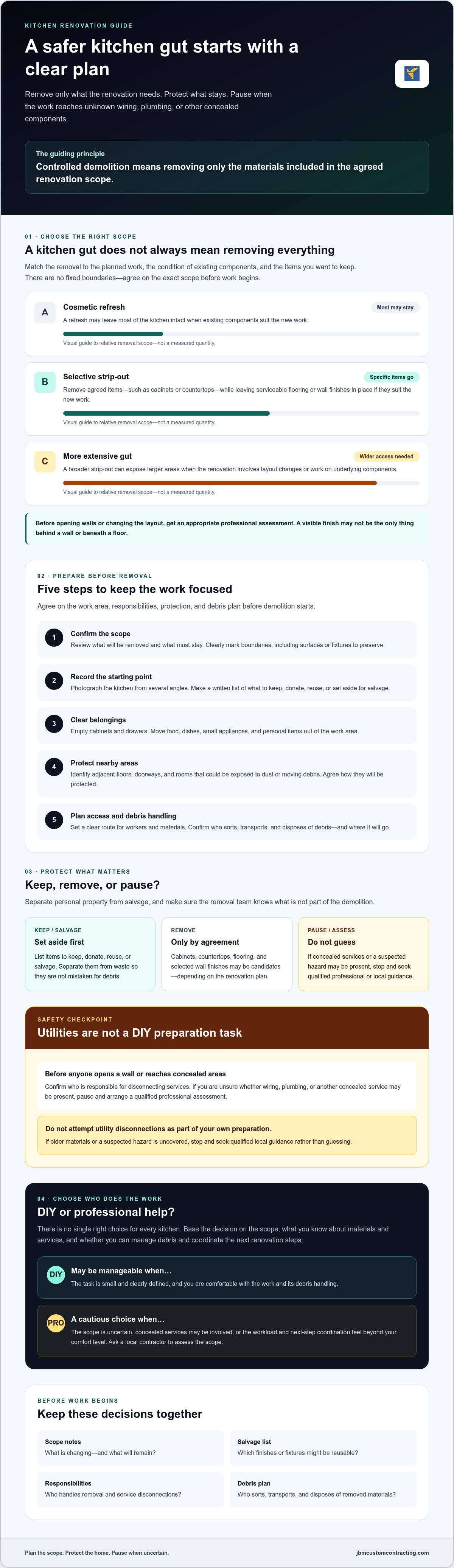
Kitchen gutting means removing selected finishes, fixtures, or components so planned renovation work can begin. That might mean taking out cabinets and countertops, or stripping back flooring and selected wall finishes. A full gut isn’t automatically necessary. The scope should match the renovation plan, the condition of the existing kitchen, and what the homeowner wants to keep.
A renovation is a process of improving an existing space, but improvement doesn’t always require removing everything. A cosmetic refresh may leave most of the kitchen intact. A partial strip-out removes specific items, while a more extensive gut can expose larger areas for layout changes or work on underlying components. There are no fixed boundaries, so agree on the exact scope before work begins.
Controlled demolition means removing only the materials included in the agreed renovation scope. Before gutting a kitchen for renovation, decide what stays, what goes, who will do the work, and how removed materials will be sorted or taken away.
Full gut or selective removal: how do the scopes differ?
Cabinets, countertops, flooring, and selected wall finishes are common candidates for removal. A smaller update may leave serviceable parts in place if their condition suits the new work. For example, replacing cabinets alone may not require removing all the flooring or wall finishes. Confirm what can stay with the renovation professional, especially where new work will meet existing surfaces.
Opening walls or changing the kitchen layout can affect concealed building components. Get an appropriate professional assessment before removing material in those areas. Don’t assume a visible finish is the only thing behind a wall or beneath a floor.
When is a kitchen gut the right starting point?
The right scope depends on the planned layout, chosen finishes, and condition of existing components. If new cabinets fit the current arrangement and surrounding finishes are in good shape, selective removal may be enough. A wider strip-out may make sense when the renovation needs access to areas that can’t otherwise be reached. Base the decision on the work ahead, not on the idea that every renovation needs a blank slate.
Before agreeing to demolition, write down your goals and identify items you hope to keep or salvage. A simple scope list can clarify conversations with contractors:
- What is changing, and what will remain?
- Which finishes or fixtures might be reusable?
- Who is responsible for removal and debris handling?
- Does the proposed work involve opening walls or changing the layout?
JBM Custom Contracting serves Nanaimo and offers demolition services. Its Nanaimo house-washing page covers a separate exterior service, not kitchen demolition.
How to Prepare Your Home Before Kitchen Demolition Begins
Good preparation keeps kitchen demolition focused and helps protect parts of your home that aren’t part of the renovation. Before gutting a kitchen for renovation, agree on the work area, who handles each task, and what happens to removed materials.
Preparation means agreeing on scope, responsibilities, protection, and disposal before removal starts. Work through these steps in order:
- Confirm the scope. Review what will be removed and what must stay with the contractor or qualified professional. Mark the boundaries clearly, including surfaces or fixtures you want preserved.
- Record the starting point. Take photos of the kitchen from several angles. Make a written list of items to keep, donate, reuse, or set aside for salvage.
- Clear belongings. Empty cabinets and drawers, then move food, dishes, small appliances, and personal items out of the work area.
- Protect nearby areas. Identify adjacent floors, doorways, and rooms that could be exposed to dust or moving debris. Agree on how those surfaces will be protected.
- Plan access and debris handling. Set a clear route for workers and materials, while considering how household members will move around the home. Confirm who will sort, transport, and dispose of debris, and where it will go.
What should homeowners remove and protect first?
Start with loose belongings, not attached fixtures. Once cabinets and drawers are empty, separate personal property from anything marked for salvage so it won’t be mistaken for waste. Walk the route materials will travel and note vulnerable flooring, narrow doorways, and nearby rooms that need protection. Keep household access in mind, particularly if people will continue using other parts of the home during the work.
What must be confirmed before anyone opens a wall?
Review the demolition boundaries before work begins, especially around walls or other areas beyond the visible finish. If you’re unsure whether wiring, plumbing, or another concealed service may be present, pause and arrange a qualified professional assessment. Confirm who is responsible for disconnecting services. Don’t attempt utility disconnections as part of your own preparation. If older materials or a suspected hazard is uncovered, stop and seek qualified local guidance rather than guessing.
For a smoother handoff, keep the photos, salvage list, scope notes, and debris plan together. If the removal workload feels beyond your comfort level, ask a local contractor whether the project fits their demolition services and confirm the scope directly before making arrangements.
DIY or Professional Kitchen Gutting: How to Choose the Right Approach
There’s no single right choice for every kitchen. The decision depends on the agreed removal scope, what you know about materials and services in the work area, and whether you can manage debris and coordinate the next renovation steps. A small, clearly defined task may suit a capable homeowner. Uncertainty calls for a more cautious approach.
| Decision factor | DIY may be manageable when... | Professional help may suit when... |
|---|---|---|
| Task scope | Removal is limited and clearly agreed. | The strip-out is extensive or affects several parts of the kitchen. |
| Homeowner experience | You’ve handled similar low-complexity work safely. | You’re unsure how to remove materials without damaging what stays. |
| Hidden services | The work avoids areas with unresolved uncertainty. | Wiring, plumbing, structural elements, or suspected hazardous materials may be involved. |
| Debris handling | You have a practical plan for sorting and moving waste. | The volume, weight, or disposal arrangements feel difficult to manage. |
| Coordination | You can fit the work around the renovation schedule. | Removal needs to align with other trades or a set project sequence. |
Which parts might a capable homeowner handle?
A homeowner may be comfortable with simple removal tasks when the materials and work area are understood, the task is within their experience, and the agreed scope is clear. Don’t take on work involving electrical, plumbing, gas, or other building services. Stop if you uncover an unexpected condition, and get qualified advice before continuing.
When should you bring in a demolition professional?
Consider professional help if the scope is complex, concealed services are uncertain, the work requires tools or waste handling you can’t manage, or removal must be coordinated with other renovation work. Anything involving structural uncertainty or suspected hazardous materials needs qualified assessment. JBM Custom Contracting lists small demolition services, but confirm directly whether the company can take on your specific kitchen removal scope.
Before hiring, ask each contractor to clarify what’s included, how adjacent areas will be protected, who handles debris, what relevant experience they have, and whether their insurance covers the planned work. Clear answers make it easier to compare proposals beyond the amount of removal included. For more questions to raise, see this demolition contractor hiring guide.
How to Gut a Kitchen in a Controlled, Renovation-Ready Sequence
Gutting a kitchen for renovation works best as a planned handoff, not a rush to strip everything out. The removal order should fit the kitchen’s layout and the agreed work plan, so there isn’t one sequence that suits every home. Use this high-level framework, then confirm the details with the professionals responsible for the work:
- Confirm the scope. Review exactly what will be removed, what must remain, and which areas are outside the work zone.
- Prepare and protect. Clear belongings and put the agreed protection in place for nearby surfaces and access routes.
- Arrange service disconnections. Confirm who is responsible for disconnecting electrical, plumbing, gas, or other building services. Qualified professionals must handle these tasks and any work that needs specialist assessment.
- Remove agreed items. Follow the project plan rather than assuming cabinets, finishes, or appliances always come out in the same order.
- Clear debris and inspect. Handle salvage and waste according to the agreed plan, then compare the cleared area with the demolition scope.
A renovation-ready handoff follows scope confirmation, controlled removal, and cleanup.
What should happen during removal and debris handling?
Keep the work area and the route out of the home orderly as removal progresses. Separate reusable items from waste only when ownership and handling plans are clear, so something intended for salvage isn’t accidentally discarded. Follow the project’s agreed approach to containing and moving debris. For unwanted items that need to be taken away, junk removal services may be one option to discuss as part of the plan.
Stop and check if removal exposes unexpected damage, concealed services, or materials of concern. Don’t continue through uncertainty. Record what you’ve found and ask the appropriate qualified professional to assess it before work resumes.
How do you know the kitchen is ready for the next phase?
Walk through the cleared kitchen with the agreed scope in hand. Check that specified items are removed and anything marked to stay is still in place. Photograph newly visible damage or unexpected conditions and share them with the renovation professional before the next work proceeds. Confirm that retained items are accounted for, debris has been dealt with as planned, and responsibilities for the work area are clear. This simple review helps prevent confusion between removal and renovation.
After Kitchen Gutting: Debris, Local Support, and Your Next Steps
Once removal is complete, confirm the handoff before the next renovation work begins. The kitchen should match the agreed demolition scope, items meant to stay should be protected, and the debris plan should be addressed. Confirm who is responsible for the next phase and when the cleared space is ready for that work.
Disposal arrangements can depend on the type of material and the provider handling it. Before debris is transported, check what the receiving facility or local provider accepts and how materials should be sorted. Don’t assume every item can go in the same load. If a new issue changes what needs to be removed, agree on the revised scope and responsibilities before proceeding.
What should you ask before the renovation work continues?
A clear handoff helps prevent misunderstandings between demolition and renovation. Ask who accepts the cleared space, what condition it should be in, and who is coordinating the next work. If removal has exposed damage or created a need for extra work, make sure the finding and any scope change are recorded and reviewed by the appropriate professional.
- Does the completed removal match the agreed scope?
- Are retained items and nearby surfaces accounted for?
- Who is responsible for the next phase and work-area access?
- Have debris and disposal arrangements been addressed?
- Are new findings documented before work resumes?
Keep the renovation plan and each contractor’s responsibilities aligned. This is especially useful if demolition, debris removal, and the next phase involve different providers.
How can local support make the project easier to manage?
If your home is in Nanaimo, Lantzville, Duncan, Ladysmith, Cedar, Parksville, Qualicum Beach, Cowichan, or Gabriola Island, confirm that a provider serves your location and can take on the specific work you need. Demolition and junk removal are separate services, though they may be coordinated when the project calls for both. JBM Custom Contracting lists renovations, small demolitions, and junk removal. Confirm directly whether your kitchen project fits its scope, and ask about relevant experience, responsibilities, and current insurance details.
If you’re also planning separate exterior upkeep, JBM offers house washing in Nanaimo. It’s a separate service and isn’t part of a kitchen gut or renovation handoff.
For a project-specific discussion, ask JBM about its renovation or demolition services and confirm whether the work fits your needs.
Contact JBM Custom Contracting
Move Your Kitchen Renovation Forward with a Clear Plan
Gutting a kitchen for renovation is safer and more manageable when removal stays within an agreed scope. Decide what will remain, protect nearby areas, and leave service disconnections or uncertain conditions to qualified professionals. Before the next phase starts, check that the agreed work is complete, retained items are protected, and debris arrangements are accounted for.
If the project feels too large or complex to handle yourself, professional help may make the handoff easier. JBM Custom Contracting lists renovations, small demolitions, and junk removal among its services, and serves Nanaimo and other Vancouver Island communities. Confirm directly whether your project fits its scope, and ask about relevant experience and current insurance details.
A careful start helps set up the rest of the renovation. Confirm your scope, responsibilities, and debris plan before removal begins.
Contact JBM Custom Contracting to discuss your kitchen renovation or demolition project.
Frequently Asked Questions
What does gutting a kitchen for renovation include?
Gutting a kitchen for renovation means removing the finishes, fixtures, or components needed for the planned work. The scope might include cabinets, countertops, flooring, or selected wall finishes, but it doesn’t automatically mean stripping the entire room. The renovation plan and condition of existing materials help determine what should go. Confirm what will be removed, what will stay, and who is responsible for each part before work begins.
Can I gut my kitchen myself?
Some homeowners may be able to handle limited, low-complexity removal if they understand the materials, have suitable experience, and can follow the agreed scope safely. DIY isn’t a good fit if the work involves uncertain wiring, plumbing, structural elements, or materials of concern. Don’t disconnect electrical, plumbing, gas, or other building services yourself. Stop if unexpected conditions appear, then ask an appropriate qualified professional to assess them.
How do you prepare a kitchen before demolition?
Start by confirming what will be removed and what must remain. Photograph the existing kitchen, record items to keep or salvage, and empty cabinets and drawers. Identify nearby floors, doorways, and rooms that need protection, then plan a clear route for workers and materials. Confirm who will disconnect services and who will handle debris. A written scope and clear responsibilities help protect belongings and reduce confusion during removal.
Do I need to remove everything for a kitchen renovation?
No, a kitchen renovation doesn’t always require a full gut. If you’re replacing cabinets while keeping the layout and other finishes, removing every surface may be unnecessary. A larger strip-out may be needed if the planned work requires access behind walls, beneath flooring, or around other components. Check the condition of items you hope to retain and make sure they suit the new plan before setting the demolition scope.
What should I do if I find unexpected wiring, plumbing, or damaged materials?
Stop removal in that area and don’t touch or disturb what you’ve uncovered. Photograph the condition from a safe distance, note where it was found, and contact the contractor or an appropriate qualified professional for assessment. This applies to uncertain wiring or plumbing, visible damage, and materials that raise concern. Don’t guess what the material is or continue work until responsibilities and next steps have been reviewed.
How should kitchen demolition debris be handled?
Follow the project’s agreed debris plan and separate salvageable items from waste only when ownership and handling arrangements are clear. Keep debris contained and access routes orderly as materials leave the work area. Before arranging disposal, confirm what the receiving provider or facility accepts and how items should be sorted. Requirements can vary, so check with the relevant local provider or authority rather than assuming all kitchen materials can be disposed of together.
Should I hire a demolition contractor to gut my kitchen?
Consider a demolition contractor if the removal scope is extensive, concealed services or structural changes are involved, debris is difficult to manage, or the work needs close coordination with renovation trades. Ask about the contractor’s relevant experience, the agreed scope, protection, debris handling, and insurance. JBM Custom Contracting lists demolition services, renovations, and junk removal. Homeowners in Nanaimo, Lantzville, Duncan, Ladysmith, Cedar, Parksville, Qualicum Beach, Cowichan, and Gabriola Island can confirm service area and project fit directly.