

Did you know that hauling away the debris often costs more than the actual labor of breaking up the concrete? Most property owners start a renovation focusing on the jackhammering, but the logistics of disposal are what usually blow the budget. When you're staring at a cracked, sinking entrance to your home, calculating the driveway demolition cost can feel like guesswork. You're likely worried about hidden surcharges at the landfill or, worse, a contractor who leaves a massive mess behind for you to clean up.
It's a valid concern. Between protecting underground utilities and managing heavy loads of asphalt or concrete, there's a lot that can go wrong. We're here to pull back the curtain on how pricing actually works in the Canadian market. You'll learn how to plan for transparent pricing, why professional debris handling is a must for safety, and what local factors on Vancouver Island influence your final bill. By the time you're finished, you'll know exactly how to secure a clean, level site without the stress of "surprise" expenses. We'll help you prepare for a professional result that leaves your property ready for its next chapter.
What is the Average Driveway Demolition Cost?
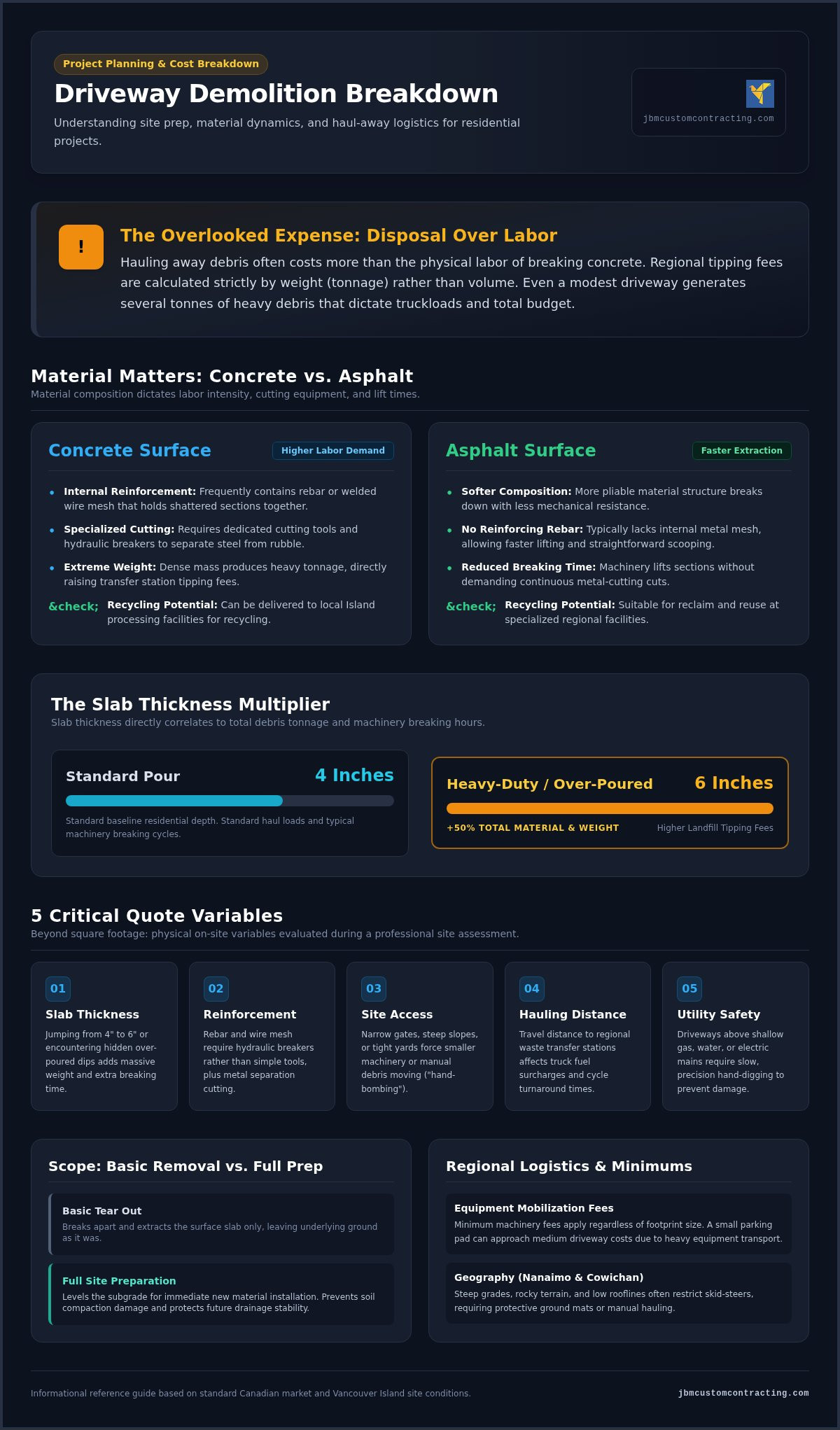
Calculating your driveway demolition cost involves more than just a simple labor estimate. It represents the total investment required to break apart existing surfaces, lift the heavy debris, and transport it to a local disposal facility. While some online calculators offer national averages, local conditions on Vancouver Island often dictate the final price. For instance, a standard residential project in Nanaimo might face different logistical challenges than one in a major metropolitan center. Relying solely on "per square foot" estimates can be misleading for small Island projects. Many contractors have minimum equipment mobilization fees that apply regardless of the size. This means a tiny parking pad might cost nearly as much to tear out as a medium driveway because the same heavy machinery is required.
There's also a significant difference between a basic tear out and full site prep. A simple removal leaves the ground as it was. Full site prep involves leveling the subgrade so it's ready for new material immediately. Professional handling ensures that the underlying soil isn't compacted or damaged during the process. This attention to detail prevents future drainage issues and creates a stable foundation for your next installation.
Material Matters: Concrete vs. Asphalt
The specific concrete driveway materials used in your original build change the complexity of the job. Concrete is generally more labor-intensive than asphalt. It's harder to break and often contains reinforcement like rebar or wire mesh. These metal components require specialized cutting tools and extra time to separate from the rubble. Asphalt is softer and typically lacks internal reinforcement, which makes it faster to lift. However, both materials can often be recycled at local Island facilities, which is a more sustainable choice than standard landfill disposal. Choosing a team that understands these material differences ensures the work stays on schedule.
The Hidden Cost of Disposal and Hauling
A major portion of your budget goes toward "tipping fees" at regional waste facilities. These fees are based on weight rather than volume. Because concrete is incredibly heavy, even a small driveway can result in several tonnes of debris. This weight dictates how many truckloads are needed and how much the landfill will charge for acceptance. If you want a seamless transition from old to new, it helps to work with a team that integrates these logistics into their quote. You can learn more about our junk removal services to see how we handle heavy debris efficiently. Proper planning prevents those "surprise" surcharges that often appear when a contractor underestimates the total tonnage of your old driveway.
5 Critical Factors That Influence Your Driveway Removal Quote
Understanding your driveway demolition cost requires looking past the surface area. While many online tools calculate price based on length and width, local contractors evaluate the physical complexity of the site. These variables determine how many hours and what type of equipment your project needs to get the job done safely. Every property on Vancouver Island presents different challenges, from soil stability to the way the original slab was poured. Five specific factors typically dictate your final quote:
- Slab thickness: A jump from 4 inches to 6 inches adds massive weight and extra breaking time.
- Reinforcement: Rebar and wire mesh require specialized cutting tools to separate from the concrete.
- Site access: Narrow entries or steep grades often limit us to smaller machinery or manual labor.
- Hauling distance: Proximity to the local waste facility affects fuel costs and truck cycle times.
- Utility safety: Precision work around gas, water, and electrical lines requires slower, careful handling.
Underground utilities are the most critical safety factor. Before any machine touches the ground, professional locates must identify vital service lines. If your driveway sits directly over a shallow utility main, the cost increases because we must use careful hand-digging or smaller tools to prevent catastrophic property damage. This meticulous approach protects your home and prevents expensive emergency repairs that could arise from a careless mistake.
Proximity to local disposal sites also impacts the quote. If your property is in a remote part of the region, travel time and fuel surcharges for heavy hauling trucks will be higher than a job located five minutes from a Nanaimo waste facility. These logistical details are why a professional site visit is always more accurate than a phone estimate.
Access Challenges in Nanaimo and Cowichan
Nanaimo's unique geography, featuring steep slopes and rocky terrain, often limits equipment access. If a skid-steer or excavator cannot reach the work area because of a narrow side yard or a low-hanging roofline, the debris must be moved manually. This process, often called "hand-bombing," significantly raises labor costs. Our team prioritizes protecting your existing landscaping, which may involve laying down protective mats for machinery. If you're worried about tight spaces, you can view our professional demolition services to see how we handle restricted access sites safely.
Reinforcement and Slab Thickness
You can often spot rebar by looking at existing cracks or the exposed edges of the slab. If you see rusted metal poking through, the demolition will require hydraulic breakers rather than simple jackhammers. Over-poured sections, where a previous builder used extra concrete to level a dip in the yard, can also hide under the surface. These thick spots add unexpected hours to the project. Slab thickness directly correlates to the total tonnage of debris being hauled and charged at the landfill. A six-inch slab contains roughly 50% more material than a four-inch slab, which results in more weight and higher tipping fees.
Comparing Demolition Methods: Manual vs. Mechanical
The method used to tear up your old surface is one of the biggest variables in your final driveway demolition cost. Choosing between manual tools and heavy machinery isn't just about speed; it's about protecting your property and managing your budget effectively. Each approach has a specific place in residential projects across Nanaimo. We evaluate the site conditions and the material type to select the most efficient path forward. While machines offer undeniable power, manual techniques provide the surgical precision needed in tight quarters.
- Jackhammers and sledgehammers: Best for small areas or projects where machinery cannot safely reach the slab.
- Heavy machinery: Skid-steers and excavators equipped with hydraulic breakers provide the force needed for large-scale removal.
- Hydraulic splitters: A "Quiet Demo" option that uses pressure to crack concrete without the vibration or noise of traditional breakers.
For noise-sensitive neighborhoods or properties with strict local bylaws, hydraulic splitters are an excellent alternative. These tools work by drilling a small hole and applying lateral pressure to snap the concrete from within. This method minimizes dust and prevents the ground-shaking vibrations that can sometimes disturb neighbors or settle nearby structures. It is a professional solution for those who want a high-quality result without the typical disruption of a construction site. If you are planning a project, you can explore our professional demolition services for Vancouver Island to see which method fits your needs.
When to Choose Manual Demolition
Manual demolition is often the most cost-effective route for small patches or areas adjacent to delicate structures like decorative retaining walls. It allows our team to work with extreme care around your home's foundation. Choosing manual labor for tiny jobs also helps you save on "mobilization fees," which are the costs associated with transporting heavy equipment to the site. If the project only involves a few square meters, a crew with electric jackhammers can often complete the work for less than the delivery fee of a large excavator. For more technical details on this process, read our Concrete Removal Services: A Professional’s Guide.
The Power of Mechanical Removal
A skid-steer is the gold standard for full driveway tear-outs because of its incredible speed and efficiency. What would take a manual crew several days of back-breaking labor can often be accomplished in a single afternoon with the right machinery. This speed advantage directly lowers your labor costs on larger projects. Machines also make it much easier to lift large chunks of debris directly into hauling trucks, keeping the job site organized and safe from start to finish.
Insert a YouTube video here showing a skid-steer concrete removal process.
Preparing Your Property for a Driveway Demo
Proper preparation is the best way to keep your driveway demolition cost from spiraling out of control. It's about more than just clearing the path for a truck. You need to consider what lies beneath the surface and how the work affects the surrounding area. Taking a few proactive steps ensures the crew can work efficiently without stopping for avoidable obstacles. When the site is ready, the machinery can move continuously; this reduces labor hours and keeps the project on schedule.
The most critical step is contacting BC 1 Call. This service identifies underground utility lines like gas, electricity, and fiber optics. In Canada, failing to do this can lead to massive fines or dangerous accidents. You should also check with the City of Nanaimo or your local municipality if the demolition involves the "curb cut" where your driveway meets the street. Some regions require specific permits to ensure the municipal infrastructure isn't damaged during the removal process. Securing these approvals early prevents legal headaches later.
Don't forget your neighbors. Demolition is loud and creates dust. A quick heads-up helps maintain good relationships and allows them to close windows or move their cars. You should also clear the work zone of any movable items. This includes vehicles, trailers, and large planters. If you have overhanging tree branches that might snag a dump truck or excavator, it's best to trim them back before the crew arrives.
Safety and Utility Locates
Utility strikes are a contractor's worst nightmare. Hitting a gas line can cost ten times more than the actual demolition itself once emergency repairs and service interruptions are factored in. Beyond the main lines, you should mark out private irrigation systems and hidden drainage pipes. These aren't typically covered by public locate services but are vital for your property's function. For more tips on choosing the right team for this high-stakes work, check out our guide on Hiring Concrete Demolition Contractors: A Complete Guide.
Post-Demo Cleanup and Site Prep
A professional demo doesn't end when the concrete is gone. The site must be left in a condition that's ready for the next phase of your renovation. This means removing every shard of debris and ensuring the sub-base is stable. A clean, properly graded site is essential for ensuring correct water drainage away from your home's foundation. We take pride in leaving your property better than we found it. You can explore our yard care and maintenance services to see how we help restore your landscape after heavy construction is finished.
Request a professional site assessment for your demolition project
Hiring a Local Pro: Why JBM Custom Contracting?
Choosing a local partner for your project ensures that the work meets regional standards and safety requirements. JBM Custom Contracting is a fully insured and certified business based right here on Vancouver Island. We understand that property owners want a clear, upfront driveway demolition cost without the fear of hidden fees or liability issues. Unlicensed operators often provide "cheap" quotes that seem attractive at first. These low prices often lead to illegal dumping or accidental damage to your home's foundation. We prioritize operational excellence and safety on every job site to give you peace of mind.
Our team provides a seamless experience by combining professional demolition with high-capacity junk removal. You don't need to coordinate with multiple contractors to get your old driveway broken up and the debris hauled away. We handle the entire lifecycle of the project from the first crack of the concrete to the final sweep of the site. This integrated approach saves you time and ensures that the area is ready for the next phase of your renovation immediately. We focus on solving your problems efficiently so you can move forward with your property improvements.
Service Area Excellence
We proudly serve communities from Nanaimo and Lantzville to Parksville and the Cowichan Valley. Each municipality has its own specific disposal requirements and bylaws regarding heavy debris. Our local expertise means we already know the tipping fees at the regional landfills and the safest routes for our hauling trucks. This localized knowledge allows us to provide a more accurate driveway demolition cost for your specific neighborhood. If you are ready to start, you can contact JBM for a demolition quote today.
The JBM Difference: Safety and Reliability
We believe a job isn't finished until the site is spotless. Our specialized equipment is designed for precision; it allows us to handle small demolitions in tight residential areas without disturbing your lawn or garden. We use action-oriented techniques to lift and remove concrete safely while protecting your underground utilities. Our commitment to reliability means we show up on time and leave your property cleaner than we found it. We treat your home with the same respect we would treat our own, ensuring a hassle-free experience from start to finish.
Ready for Your Next Driveway Project?
Planning for your driveway demolition cost doesn't have to be a source of stress. By understanding how material thickness and site access affect the final bill, you can avoid those frustrating unexpected surcharges. We've explored how professional equipment and proper utility locates prevent property damage while keeping the project on schedule. A successful removal is about more than just breaking concrete; it's about managing the heavy logistics of disposal and site preparation to ensure a smooth transition for your property.
As local Vancouver Island experts, JBM Custom Contracting provides a comprehensive demo and junk removal service that handles every detail of the process. We are fully insured and certified to work in Nanaimo and the surrounding communities, focusing on operational excellence and safety. This ensures your property is left clean, level, and perfectly prepped for your new installation. You can move forward with confidence knowing that the heavy lifting is handled by a team that prioritizes precision and reliability.
Get a Professional Driveway Demolition Quote from JBM
We look forward to helping you transform your property with a professional, no-hassle demolition that gets the job done right.
Frequently Asked Questions
Do I need a permit to demolish my driveway in Nanaimo?
In Nanaimo, you generally don't need a permit to remove a concrete slab on your own private property. However, if the work involves the municipal boulevard or the "curb cut" where your driveway meets the street, you must contact the City of Nanaimo for a permit. It's always best to verify with local bylaws in Lantzville or the Cowichan Valley before starting, as regulations can vary between regional districts.
Can I save money by breaking up the concrete myself?
You might save on initial labor costs by breaking up the material yourself, but you still face the challenge of hauling and disposal. Concrete is incredibly heavy and requires specialized trucks for transport. Without professional equipment, you risk injury or property damage. Most homeowners find that the total driveway demolition cost stays similar once they factor in tool rentals, truck fees, and the physical toll of manual labor.
How long does a typical driveway demolition take?
A standard residential driveway demolition typically takes between one and two days. This timeline includes breaking up the surface, loading the debris into hauling trucks, and performing a final site cleanup. Smaller projects in areas like Parksville or Cedar might be finished in a single afternoon with mechanical equipment. Factors like slab thickness, reinforcement, and site accessibility will ultimately determine how many hours the crew needs on-site.
What happens to the old concrete after it is removed?
Most of the old concrete removed from Vancouver Island properties is transported to local recycling facilities. These centers crush the debris into various sizes of gravel or "road base" for future construction projects. Recycling is a sustainable alternative to the landfill and often helps manage the overall driveway demolition cost. We prioritize environmental responsibility by ensuring that usable materials are diverted from the waste stream whenever possible.
Will the heavy machinery damage my lawn or sidewalk?
We take specific precautions to protect your property during the removal process. Our team uses protective mats or plywood to distribute the weight of skid-steers and excavators across your lawn. While heavy machinery is necessary for efficiency, our certified operators prioritize precision to avoid cracking sidewalks or damaging existing landscaping. We focus on leaving your yard in excellent condition so it's ready for your next property maintenance project.
Is asphalt cheaper to remove than concrete?
Yes, asphalt is generally cheaper and faster to remove than concrete. It is a softer material that doesn't typically contain the heavy rebar or wire mesh found in concrete slabs. Because it's easier to break and lift, the labor hours are usually lower. However, disposal fees are still based on weight, so the total tonnage remains a significant factor in the final price of the project.
How much should I budget for disposal fees on Vancouver Island?
Disposal fees on Vancouver Island are calculated by weight at regional waste facilities. Tipping rates for concrete and asphalt can change based on local demand and facility regulations in Nanaimo or the Cowichan Valley. Because these materials are extremely dense, the weight adds up quickly. We include these logistics in our transparent quotes so you don't face unexpected surcharges when the debris reaches the scale at the landfill.
Can you remove a driveway that has a radiant heating system?
We can remove driveways with radiant heating, but it requires a careful approach to avoid damaging the underlying connections. Our team must identify where the system connects to your home's utilities before demolition begins. If you plan to replace the heating system, we ensure the site is cleared safely. If you want to preserve parts of it, the process becomes more technical and requires slower, manual demolition techniques for safety.