


Concrete driveway replacement cost depends on the driveway’s size, concrete specifications, reinforcement, excavation, and base preparation. Replacing a worn driveway can improve its appearance and everyday function, but it does not automatically increase a home’s sale value.
It’s natural to want a clear per-square-foot estimate before deciding whether to replace your driveway. The total depends on the finish you choose and the work needed to remove the old surface and prepare the site.
This guide explains the factors that shape concrete driveway replacement cost in Canada, including concrete, reinforcement, excavation, and base preparation. You’ll also learn how to compare project scopes and weigh replacement against your property’s condition and needs.
Key Takeaways
- Compare estimates on a per-square-foot basis, then account for the driveway’s size, finish, and site conditions.
- Concrete thickness and reinforcement should suit how the driveway will be used, especially if it will carry heavier vehicles or frequent traffic.
- Decorative finishes such as exposed aggregate or stamped concrete can raise the project total compared with a basic finish.
- Excavation and a properly prepared sub-base matter: ground conditions and the work needed to remove the old surface affect the scope.
- Use the decision guide to weigh the driveway’s condition, desired finish, and preparation needs before choosing a replacement approach.
Concrete mix thickness and reinforcement
Driveway size, slab thickness, and reinforcement can all affect the total. A larger surface needs more concrete, a thicker slab requires more material, and reinforcement adds materials and installation work. Compare these specifications alongside the finish.
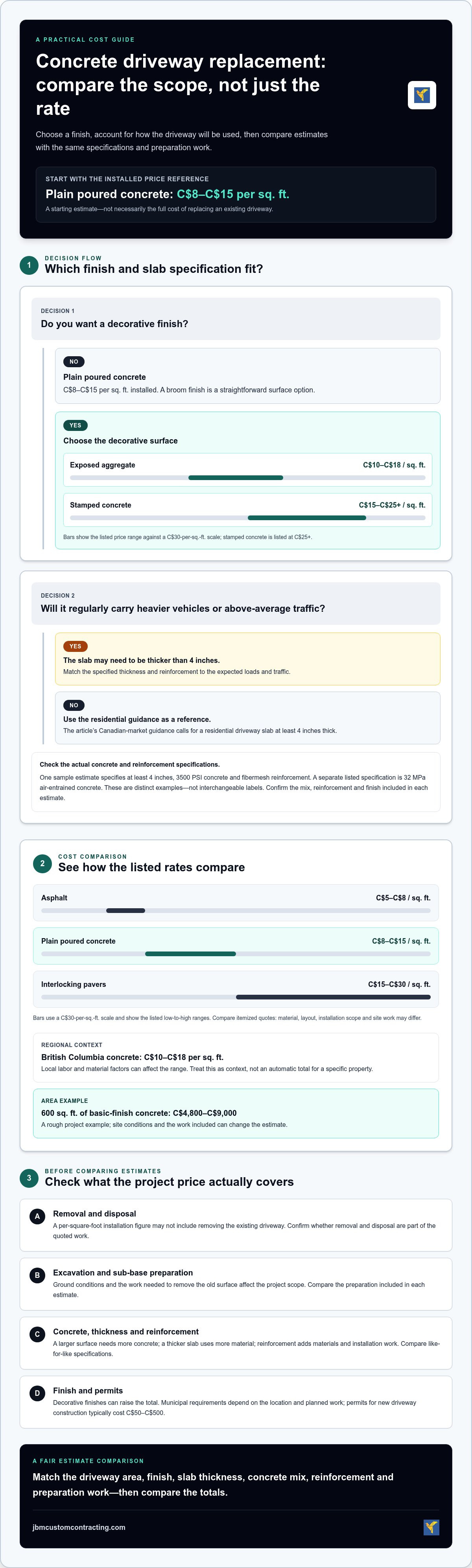
For a residential driveway, the guidance in the Canadian market calls for a slab at least 4 inches thick. Heavy-duty vehicles or above-average traffic may require a thicker slab. This matters because thickness affects the volume of concrete needed across the entire surface. A small increase in depth adds more material over every square foot.
Start with how the driveway will be used. A surface for passenger vehicles has different demands from one that regularly carries heavier vehicles. The design should suit the expected loads and traffic, rather than relying on a thinner specification to reduce the initial scope.
Mix specifications matter, too. A sample driveway estimate uses concrete at least 4 inches thick, rated at 3500 PSI, with fibermesh reinforcement. Separately, some driveway installation price examples list 32 MPa air-entrained concrete as included. These are distinct specifications from separate examples, not interchangeable labels. Ask what mix and reinforcement an estimate includes before comparing its total with another.
| Option | Thickness or mix | Reinforcement | Finish | Best comparison point |
|---|---|---|---|---|
| Basic residential use | At least 4 inches | Confirm what is included | Broom finish | Slab depth and included mix |
| Heavier vehicles or above-average traffic | May need more than 4 inches | Match reinforcement to design | Choose based on use | Specified thickness and load |
| Example estimate | At least 4 inches; 3500 PSI | Fibermesh | Confirm the finish | Mix and reinforcement details |
| Another listed specification | 32 MPa air-entrained concrete | Check the estimate details | Confirm the finish | Exact mix stated |
Reinforcement can help limit crack movement, but it doesn’t replace an appropriate slab design or careful preparation. Fibermesh is one option named in the sample estimate. The estimate should state whether reinforcement is included, what type is specified, and where it will be used. That makes the scope easier to compare without assuming every quote covers the same build.
A broom finish is a straightforward surface option, while concrete specifications and reinforcement describe other aspects of the slab. Keep these factors distinct when reviewing estimates. Choose specifications suited to expected vehicle loads and traffic, then compare quotes using the same thickness, concrete, reinforcement, and finish.
Estimated concrete driveway cost per square foot
Understanding the concrete driveway replacement cost starts with looking at typical averages. A plain poured concrete driveway in Canada averages C$8 to C$15 per square foot installed. Use that range as an initial estimate, then consider the driveway’s area, finish, and full project scope. A per-square-foot figure may describe installation alone, not every task involved in replacing an existing driveway.
These examples show how area affects a rough total. For instance, a standard 600-square-foot project typically ranges from C$4,800 to C$9,000 for basic finishes. They do not account for every site condition or finish, so compare the work included before treating estimates as equivalent.
Regional figures can provide context for homeowners. In British Columbia, prices often range between C$10 and C$18 per square foot due to local labor and material factors. Because ranges may differ in scope and location, use details from the property rather than assuming either predicts its total.
Finish also changes the per-square-foot comparison. Decorative options like exposed aggregate usually cost C$10 to C$18 per square foot, while stamped concrete can range from C$15 to C$25+ per square foot. For a 600-square-foot driveway, these additions apply across the finished area, making the chosen surface an important part of the estimate.
How does concrete compare with asphalt or pavers in Canada? Asphalt generally costs C$5 to C$8 per square foot, while interlocking pavers range from C$15 to C$30 per square foot. Paver estimates depend on the material, layout, and installation scope, so compare itemized quotes rather than assuming the same rate.
What permits or municipal rules apply to replacing a driveway in Canada? Requirements depend on the municipality and the work planned. Municipal permits for new driveway construction typically cost C$50 to C$500, so include permit needs in project planning.
How long does replacement take, and when can the driveway be driven on? The work may include removal, preparation, concrete placement, and curing. Vehicle access depends on curing progress, while weather and site conditions can affect the sequence. Plan to keep the area inaccessible during work and curing.
| Option | Typical Canadian estimate | What to compare |
|---|---|---|
| Plain poured concrete | C$8 – C$15 per sq. ft. | Area, preparation, and included work |
| British Columbia concrete | C$10 – C$18 per sq. ft. | Local site conditions and project scope |
| Asphalt | C$5 – C$8 per sq. ft. | Equivalent driveway area and scope |
| Exposed aggregate | C$10 – C$18 per sq. ft. | Selected finish and finished area |
| Stamped concrete | C$15 – C$25+ per sq. ft. | Pattern and finish selection |
For a clear comparison on your next project with JBM Custom Contracting, measure the driveway and note your preferred finish. Then check whether each estimate includes removal of the existing surface, preparation, concrete, and finishing. This breakdown helps explain differences between quotes beyond a single square-foot figure.
Excavation and sub-base preparation
Ground preparation affects how the new driveway sits and drains. In Canada’s freeze-thaw climate, excavation and a stable granular base are important parts of the project scope.
Sub-Base Preparation
A sub-base is the compacted granular layer beneath the concrete. It creates a firm foundation, unlike the slab itself, which forms the visible driving surface. In Canadian freeze-thaw climates, a compacted granular sub-base should be 150 to 300 millimetres deep. Some listed driveway prices include a 6-inch compacted granular base, so check whether an estimate includes this material and work.
Preparation involves removing unsuitable material and shaping the ground to support the planned driveway. The base is placed and compacted before concrete is poured. These steps matter because the new surface relies on the material beneath it as well as the concrete itself. Check that the scope clearly describes the base and compaction work.
Excavation depth depends on the existing surface, soil, and design. One example estimate covers optional slab excavation to a maximum depth of 8 inches. Treat this as an example scope and amount, not a standard rate for every driveway.
Compare preparation line by line. An estimate that includes a 6-inch granular base differs from one that lists the base as extra. A deeper excavation or additional removal of unsuitable ground can also change the work required. Clear details help explain why two estimates for the same surface area may have different totals.
Concrete Removal and Disposal
Removing an existing concrete driveway involves breaking up the old slab, clearing the pieces, and arranging disposal. Sub-base preparation creates the foundation for the new surface; removal deals with the existing material and its waste. For a replacement, look for demolition and disposal as distinct parts of the scope.
Concrete removal estimates can use different pricing bases. These are different estimate formats, so do not add them together automatically.
For a useful comparison, check whether removal includes breaking the slab, loading debris, hauling, and disposal. The driveway’s area and the amount of concrete affect the work involved. Disposal may be listed separately from tear-out, so review each line before comparing totals.
Keep removal and excavation distinct in the estimate. Removing the old concrete clears the site; excavation shapes the area for the new build. Listing both tasks and the granular base details makes the preparation plan easier to understand and compare.
Factors that affect replacement pricing
Driveways with similar areas can still require different work. Shape, access, surface condition, location, and finish all affect the scope. For homeowners on Vancouver Island, compare estimates based on the actual property and included work, not square footage alone.
Shape changes forming and finishing work. Curved driveways typically cost 10% to 20% more than straight designs. A sweeping entrance, for example, needs more careful shaping than a direct path from the street to a garage. Include curves, flared entrances, and side parking areas when describing the layout. A basic length-and-width measurement may miss these details.
Access also shapes the work plan. A narrow entrance, nearby walls, or landscaping close to the driveway can affect how equipment and materials reach the site. Describe these conditions and obstacles clearly. Across Vancouver Island communities, access can vary from one property to another, even when driveway areas are similar.
The existing surface affects the replacement scope. Widespread damage may require removing more material than limited deterioration. Once the old surface is removed, ground conditions can affect excavation and base preparation. Keep removal, disposal, excavation, and sub-base preparation visible as separate estimate items to see what each quote covers.
The finish can also affect the estimate. A broom finish and a decorative surface may require different materials or finishing work. Compare quotes using the same finish and slab specifications. Otherwise, a higher estimate may simply include a different surface treatment or more detailed work.
How can homeowners get accurate quotes and manage replacement costs? Give JBM Custom Contracting the same measurements, photos, access details, and finish preference you would use to define the project scope. Ask for an estimate that identifies labour, materials, equipment, removal, disposal, preparation, and exclusions. This makes the scope easier to understand and separates optional upgrades from planned work.
Start by choosing a scope suited to how you use the driveway. Keep the layout straightforward where practical and choose a finish that meets your priorities. Compare like with like: do not weigh a simple design against a quote with extra features, or remove necessary preparation and concrete specifications just to lower an estimate on paper.
Your project price depends on dimensions, shape, access, existing conditions, preparation, materials, and finish. The exact figure is provided in a quote for your case.
Before comparing estimates, make sure they use the same project details:
- Measure the complete driveway layout, including curved or widened sections.
- Describe site access and nearby obstacles.
- Specify the same finish and concrete requirements for each estimate.
- Check whether removal, disposal, and preparation are included.
A clear scope explains differences between quotes. Review the work listed first, then compare totals against the tasks and materials each estimate includes.
How much does it cost to remove and dispose of an existing concrete driveway?
Removal and disposal are separate parts of a replacement estimate. Work may include breaking the slab, loading concrete pieces, hauling debris, and arranging disposal. A quote for demolition alone may not include hauling or disposal, so compare the listed tasks before weighing totals.
Confirm what the removal line includes. Does it cover the full driveway or only a damaged section? Does the scope include loading and hauling? Is disposal included or listed separately? These details show whether the estimate covers the full removal process or only breaking up the old surface.
Area matters because it determines how much concrete must be broken and cleared. A wide apron beside a garage, for example, adds material beyond the straight strip leading from the street. Slab thickness and reinforcement may also affect the work needed to break it apart. Include the full layout and visible slab details when describing the project.
Access matters, too. A clear route from the driveway to the street can make it easier to move equipment and debris. A narrow side passage, nearby landscaping, or walls close to the slab can change how removal proceeds. Point out these conditions before work begins so the plan reflects the property.
Disposal is distinct from demolition. Breaking concrete creates debris; that debris then needs to be collected, transported, and handled appropriately. Ask for the estimate to separate concrete removal from disposal when possible. This makes it easier to identify which part affects the project total, especially when disposal arrangements differ.
Removal leads into the next stage. After the old slab and debris are cleared, the area may need excavation and sub-base preparation before new concrete is placed. Keep these tasks separate in the scope, so a removal estimate does not appear to cover preparation that is excluded.
For a practical comparison, give each contractor the same driveway measurements and site details. Include photos of the whole slab, access points, edges, and any obstacles. Then compare whether each estimate includes:
- Breaking and removing the entire old concrete surface
- Loading and hauling the broken pieces
- Disposal arrangements for the concrete debris
- Clearing the site for excavation and base preparation
Those four items help distinguish partial demolition from complete site clearing and make disposal less likely to be overlooked. Keep removal and preparation visible as separate line items, then compare the full scope rather than one isolated figure.
Explore concrete demolition services
JBM Custom Contracting: Renovations
JBM Custom Contracting helps homeowners plan property renovations that include driveway replacement. Selected small demolition and removal projects are reviewed for what will be removed, what will stay, and how waste will be handled. Junk removal can also help with unwanted materials as part of property cleanup.
Reach out when you’re organizing removal and cleanup alongside other renovation work. Share the property address, driveway measurements, site photos, access details, and a clear list of planned tasks so the project scope can be reviewed.
Contact JBM Custom Contracting about your renovation project
Make a confident plan for your driveway
Before planning a replacement, decide what you need the driveway to do every day. Consider vehicle use, property access, and how the surface should fit the home. Clear priorities help turn a concrete driveway replacement cost estimate into a practical plan, rather than a number considered on its own.
If the project includes wider exterior upkeep, JBM Custom Contracting also provides Moss & Gutter Cleaning. The company offers a free consultation for exterior cleaning. Keep related property tasks in mind, while focusing driveway decisions on the surface, site, and work required.
JBM Custom Contracting can help with property improvements and demolition work connected to renovation plans. When you’re ready to discuss the project and its next steps, share the scope and your priorities.
A well-planned project starts with clear priorities. Take the next step when it feels right for your home.
Frequently Asked Questions
Does a concrete driveway increase home value?
A new concrete driveway can improve curb appeal and make the entrance more functional, but it does not guarantee a higher sale price. Its value depends on the home, neighbourhood, driveway condition, and overall presentation. Replacing a cracked entrance, for example, may address a visible maintenance concern. Treat the upgrade as part of the property’s condition, not a guaranteed return on investment.
Should I repair or replace my concrete driveway?
Repair may suit isolated damage when the surrounding slab remains sound. Replacement is worth considering when cracking, uneven areas, or deterioration affect much of the surface. Look at where damage appears, whether sections have shifted, and how well water drains. A few isolated defects differ from widespread problems. The right choice depends on the damage and whether repairs can address its cause.
What’s the average cost of a concrete driveway?
A plain poured concrete driveway in Canada averages . For a rough estimate, measure the driveway’s area and multiply it by that range. Concrete driveway replacement cost may also include removal and site work, so this calculation is only a starting point. A larger driveway uses more concrete than a smaller one, even with the same finish.
What is the average cost to replace a concrete driveway in Canada?
Concrete driveway replacement cost depends on both the new installation and the existing surface. Compare estimates that separate removal, disposal, preparation, and new concrete work.
How much does a concrete driveway cost per square foot in Canada?
Check that estimates use the same finish and scope. This makes per-square-foot figures more useful when comparing equivalent work.
What factors affect the cost of replacing a concrete driveway?
Key factors include driveway dimensions, slab specifications, reinforcement, finish, site access, and preparation beneath the concrete. Shape matters, too: a curved layout can require more forming and finishing than a straight approach. For a specific estimate, provide accurate measurements and describe access restrictions, existing damage, and your preferred finish. These details clarify the scope beyond surface area alone.
What are the risks and extra costs of replacing a concrete driveway?
Extra work can arise if removal, disposal, excavation, or base preparation falls outside the initial scope. Ground conditions may also affect the preparation needed after the old surface is cleared. Municipal permits for new driveway construction typically cost C$50 to C$500. Review each estimate’s inclusions and exclusions, especially where disposal and preparation appear as separate items.
How long does concrete driveway replacement take, and when can it be driven on?
The work may include removing the old driveway, preparing the site, placing concrete, and allowing it to cure. Vehicle access depends on curing progress. Weather and site conditions may affect scheduling, so plan to keep the area inaccessible during the work and curing period.


