
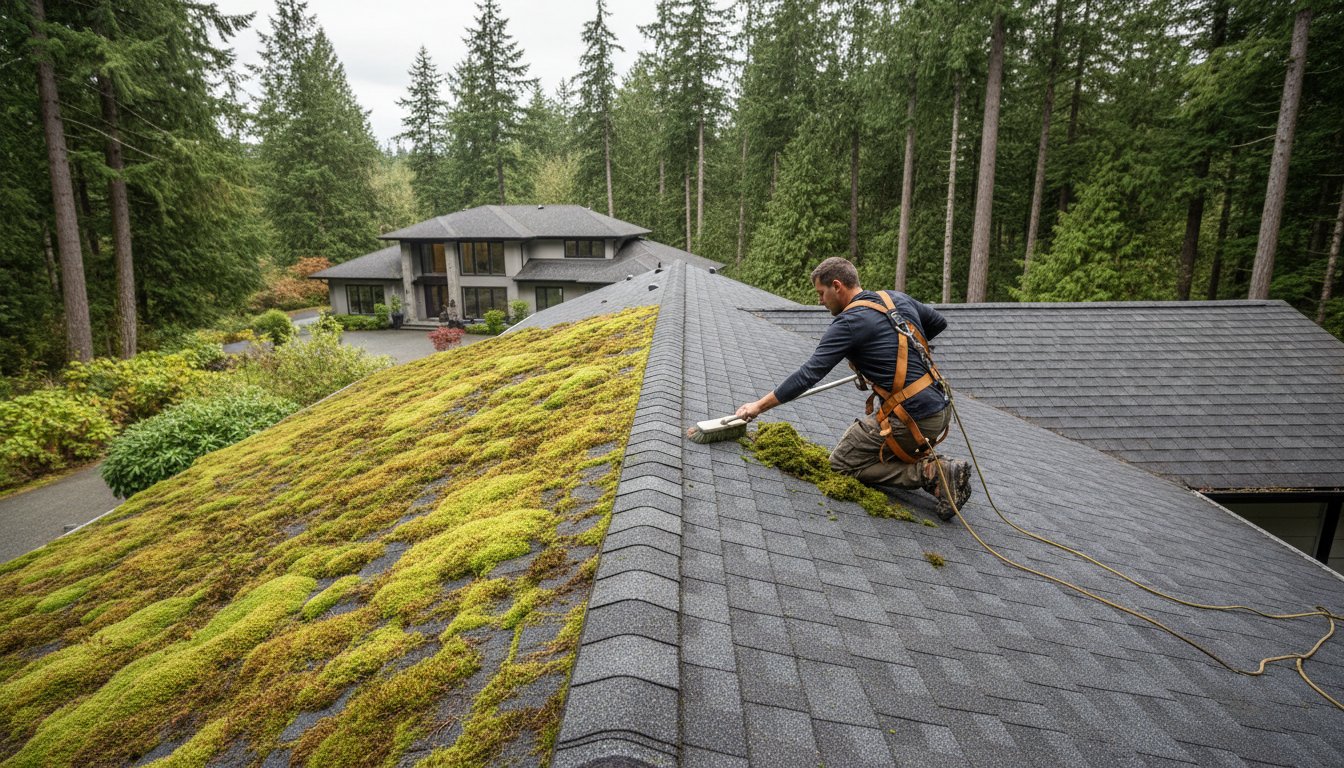

Did you know that a single season of Vancouver Island humidity can allow moss to lift asphalt shingles by as much as 3 millimetres, inviting rot directly into your roof deck? It's frustrating to look up and see those thick green clumps spreading across your home, especially when you know how slippery and dangerous those surfaces become during our wet Nanaimo and Duncan winters. Most homeowners we speak with want a clean roof but are rightfully worried that the wrong cleaning method might strip away protective granules or void a 25 year manufacturer warranty entirely.
We understand those concerns because we've seen the damage that aggressive, uncertified cleaning can do. This guide will show you that removing moss from asphalt shingles doesn't have to be a gamble. You'll learn the specific, non-destructive techniques we use to safely eliminate growth and extend the lifespan of your roof by up to 15 years. We'll walk you through the professional tools and eco-friendly solutions that deliver a moss-free finish without risking the structural integrity of your home.
Why Moss is a Constant Battle for Vancouver Island Roofs
Living on Vancouver Island offers incredible views, but it also presents a relentless challenge for your home's exterior. The stretch of land from Duncan to Qualicum Beach is often referred to by local professionals as the "Moss Belt." In this region, the average annual rainfall often exceeds 1,100 millimeters. This high volume of water, combined with our consistent coastal humidity, creates a literal paradise for organic growth. If you're a homeowner in this area, removing moss from asphalt shingles isn't just about curb appeal; it's a necessary part of property maintenance that protects your investment. You'll likely notice growth starting in the small gaps between shingles where water lingers longest after a typical West Coast downpour.
Asphalt shingles are designed to shed water, but their textured surface is unfortunately perfect for catching wind-blown spores. When moisture gets trapped in the gaps between shingles, it creates a micro-environment where plants can thrive. To understand the biology behind this, you might ask, What is moss? It is a resilient organism that doesn't need soil to grow, making your roof tiles the perfect substrate for a colony to start. Unlike grass or garden plants, these organisms thrive in the acidic environment created by decaying organic matter like pine needles and falling leaves.
To better understand the process of identifying and clearing these growths, watch this helpful video:
The Nanaimo Climate Factor
Nanaimo homeowners face specific environmental pressures that accelerate roof decay. During the peak rainy season from October to April, roofs in shaded lots rarely have the chance to dry out completely. In communities like Cedar and Ladysmith, the heavy presence of Douglas Fir and Bigleaf Maple trees adds another layer of trouble. Falling needles and leaves trap moisture and provide nutrients for moss colonization. We've observed that north-facing roof planes in these neighborhoods suffer from 60% more moss growth than south-facing ones due to the lack of direct UV exposure and 40% less sunlight during winter months.
Properly managing the canopy over your home is a critical first step in moss prevention. For those in the Pacific Northwest seeking professional guidance on tree health and clearance, CDA TREE AND UTILITY offers expert services to ensure your trees are an asset rather than a threat to your roof's longevity.
Moss vs. Algae: Know Your Enemy
It's common to mistake black streaks for simple dirt or soot. However, those dark stains are usually Gloeocapsa Magma, a hardy type of algae that feeds on the calcium carbonate fillers in modern asphalt shingles. While these streaks look bad, the thick green cushions of moss are the real structural danger. These plants don't have traditional roots, but they use tiny anchors called rhizoids to grip the ceramic granules of your shingles. Roof moss is a non-vascular plant that acts like a sponge on your shingles. This sponge effect keeps the roof deck in a state of constant saturation, which eventually rots the wood underneath. Removing moss from asphalt shingles early prevents this moisture from seeping into the structural plywood, saving you from a C$15,000 roof replacement down the road.
Identifying the specific type of growth is the first step in our professional cleaning process. While algae can often be treated with a gentle chemical wash, established lichen and moss require a more patient approach to ensure the shingles aren't stripped of their protective granules. Our team focuses on safe and reliable methods that prioritize the long-term health of your roof over a quick, aggressive fix. We ensure that every job is handled with the precision needed to keep your home dry and your warranty intact.
How Moss Actually Damages Your Asphalt Shingles
Moss might look like a soft green carpet, but it's actually a silent destroyer of Canadian roofing systems. Unlike garden plants, moss doesn't have traditional roots. It uses tiny, hair-like anchors called rhizoids to secure itself. These rhizoids don't just sit on the surface; they wrap around and dig into the ceramic granules that protect your shingles. When you're removing moss from asphalt shingles, you'll often see these granules come off with the plant, leaving the underlying asphalt exposed to the elements.
The damage intensifies during our Canadian winters. Moss acts as a sponge, holding onto significant amounts of water. When temperatures drop below zero, that trapped water expands by approximately 9% as it turns into ice. This process, known as frost heave, creates a powerful mechanical force that pries the shingles apart. Once a shingle is lifted even a few millimetres, it loses its seal. This allows wind-driven rain to blow underneath, leading to leaks that often go unnoticed until they hit your ceiling drywall.
Ignoring these green patches carries a heavy price tag. A standard architectural shingle roof is typically designed to last 25 years. However, a heavy moss infestation can reduce that lifespan to just 12 or 15 years. Replacing a roof a decade early can cost a homeowner anywhere from C$8,000 to C$16,000, making regular maintenance a critical financial decision.
Granule Loss and UV Protection
The ceramic granules on your shingles aren't just for colour; they're the primary line of defence against the sun. Moss strips these granules away, leaving the raw asphalt vulnerable. Without this protection, UV rays bake the asphalt, causing it to become brittle and crack. On a 30°C summer day, bare asphalt can reach temperatures exceeding 70°C, accelerating the breakdown of the shingle's internal structure. Following an OSU Extension Service guide to moss removal can help you understand the delicate balance required to clean these surfaces without causing further granule loss.
Moisture Retention and Structural Rot
Moss creates a micro-climate on your roof that stays damp for weeks after a single rainstorm. This constant moisture eventually seeps through the shingle layers and reaches the wooden roof deck. Once the plywood deck absorbs this water, it begins to soften and rot. By the time you see dark spots on your attic rafters or notice a musty smell, the structural integrity of the roof may be compromised. Replacing rotted roof sheathing can add C$3,000 to C$5,500 to the cost of a standard roof job. If you notice shingles that feel "spongy" when walked on, it's a clear warning sign that moisture has bypassed your underlayment. Before the damage spreads to your interior, a professional roof assessment can identify exactly how deep the moisture has penetrated.
Soft Washing vs. Pressure Washing: The Great Roof Debate
Homeowners across Canada often face a difficult choice when they spot green clumps spreading across their roof. The instinct to grab a pressure washer and "blast" the problem away is strong, but it's a move that usually backfires. While a pressure washer is great for a concrete driveway, it is a destructive tool for a delicate roofing system. Choosing the right method for removing moss from asphalt shingles determines whether your roof lasts another fifteen years or requires a C$12,000 replacement next season.
The Dangers of High-Pressure Cleaning
A standard residential pressure washer typically operates at 3,000 PSI. At this intensity, the water stream acts like a saw. Asphalt shingles are coated with ceramic granules that protect the underlying bitumen from UV rays. High pressure strips these granules away instantly. Losing just 15% of your granules can reduce the lifespan of your shingles by a decade. Beyond surface damage, high-pressure streams often force water upward under the laps of the shingles. This bypasses the weatherproofing and drives moisture into the plywood decking and attic insulation, leading to mould growth that you won't see until the damage is severe. In these instances, consulting with a specialist like Standard Insulation can help ensure that your attic's thermal performance is restored and protected from further moisture damage.
Understanding the power ratings of these machines is crucial to avoid causing irreversible damage. To learn more about the specific capabilities and maximum PSI levels of modern pressure washers, you can visit PBC Pressure Cleaning for a helpful guide. This knowledge reinforces why such powerful tools are unsuitable for delicate roofing materials.
Some people try to avoid the "power" and use a stiff brush to scrub the moss away. This is equally risky. Moss attaches itself to the shingles using root-like structures called rhizoids. When you scrub or blast the moss, you aren't just taking the plant; you're taking a layer of the shingle with it. This creates pits and scars that allow the next batch of moss to take hold even deeper than before.
The Soft Wash Solution Explained
Soft washing is the only method JBM Custom Contracting recommends for maintaining property value and structural integrity. Instead of using brute force, this process relies on a low-pressure delivery system, usually under 100 PSI, which is comparable to the pressure from a garden hose. The secret lies in the chemistry. We use a specialized blend of biodegradable surfactants and sodium hypochlorite to treat the infestation. This solution doesn't just rinse the surface; it penetrates the moss and kills the spores at the root level.
This Oregon State University Extension Service guide highlights that effective moss control requires specific solutions to prevent immediate regrowth. Soft washing provides a "set and forget" benefit. Once the solution is applied, it continues to work for weeks. The dead moss eventually loses its grip and washes away naturally during the next few rainstorms. Because the spores are chemically neutralized, your roof stays clean for two to three times longer than it would after a standard pressure wash. This method is the professional standard for removing moss from asphalt shingles without compromising the roof's seal.
To see how professionals apply these techniques for various exterior surfaces, you can explore Soft Washing Services that specialize in this safe and effective method.
Industry standards are clear on this debate. The Asphalt Roofing Manufacturers Association (ARMA) and major manufacturers like GAF and CertainTeed specifically warn against high-pressure cleaning. In many cases, using a pressure washer on your roof will actually void your manufacturer's warranty. Professional soft washing follows these strict guidelines to ensure your home remains protected and your warranty stays intact. It's a safer, more efficient approach that prioritizes the long-term health of your Canadian home over a quick, temporary fix.
DIY Moss Removal: Risks, Rewards, and Best Practices
Taking on the task of removing moss from asphalt shingles yourself can save you a few hundred dollars in labor costs, but it requires a level of physical fitness and caution that most home maintenance jobs don't demand. On Vancouver Island, where damp conditions make moss growth a year-round reality, many homeowners in Nanaimo and Duncan attempt this every spring. While the rewards include an immediate boost in curb appeal, the risks to your safety and your roof's integrity are high if you use the wrong methods.
The most effective DIY approach for heavy growth is the gentle brush technique. You'll need a soft-bristle brush with an extension pole to reach clumps without overextending your body. Always brush in a downward motion, following the direction of the shingles. Brushing upward or sideways can lift the shingle tabs, breaking the sealant bond and inviting leaks. If the moss doesn't come off with light pressure, stop immediately. Forcing it will tear away the protective ceramic granules that shield your roof from UV rays. You should never use a pressure washer on asphalt shingles. Even at low settings, high-pressure water can strip away years of shingle life in minutes, often voiding your manufacturer warranty.
Homemade vs. Commercial Cleaning Solutions
The Asphalt Roofing Manufacturers Association (ARMA) recommends a specific 50:50 ratio of laundry strength chlorine bleach and water for safe cleaning. This solution effectively kills moss spores without eroding the asphalt. Many people try using dish soap or vinegar as an eco-friendly alternative, but these are often ineffective. Vinegar is highly acidic and can react poorly with certain shingle components, while dish soap leaves a film that can actually attract more dirt. To protect your Duncan or Nanaimo garden, thoroughly soak your plants and grass with fresh water before and after the application to dilute any bleach runoff.
Roof Safety 101 for Homeowners
Safety is the biggest hurdle for any DIYer. Wet moss is arguably the slipperiest substance you'll ever encounter on your property. It acts like a sponge, holding moisture that creates a slick, slimy surface the moment you step on it. Statistics from the Canada Safety Council suggest that falls from heights are a leading cause of serious home injury, so you should never work alone. Always have a spotter on the ground to steady the ladder and call for help if needed. If your roof has a pitch steeper than 4:12, you must use a fall-protection harness and specialized roof boots with high-traction soles.
Given these risks, many homeowners decide that hiring a licensed and insured professional is the wisest course of action. While this article focuses on Vancouver Island, the principles of hiring a qualified expert are universal. For instance, homeowners in the Pacific Northwest can visit Local Fishing Handyman LLC, a company that emphasizes proper licensing and insurance for all its home maintenance services.
Similarly, for larger exterior renovations like custom swimming pools, homeowners value specialists like Marlin Exteriors, Inc. who bring dedicated expertise to the project.
When it comes to the specific task of exterior cleaning, especially for delicate surfaces, professional companies like Poseidon Power Washing LLC demonstrate the type of specialized equipment and techniques homeowners should look for.
Similarly, other critical roof components like chimneys need regular professional attention to prevent fire hazards and water leaks. For a clear example of specialized care in this area, homeowners can look to the standard set by the Best Chimney Services.
You should call it quits and hire a professional if the moss covers more than 25 percent of your roof or if you see shingles that are already curling or brittle. Trying to scrub a failing roof will only accelerate the need for a total replacement, which can cost upwards of C$10,000 for an average-sized home. If you're uncomfortable with heights or the moss is too stubborn for a soft brush, the safest move is to step off the ladder. Our team provides professional moss removal services that protect your shingles and your safety.
- Essential Tools: Soft-bristle brush, extension pole, garden hose with a spray nozzle, and a sturdy ladder.
- Safety Gear: Slip-resistant footwear, safety glasses, chemical-resistant gloves, and a fall-arrest harness.
- The 4:1 Rule: For every 4 feet of height, the base of your ladder should be 1 foot away from the wall.
- Timing: Work on a cloudy, calm day to prevent the cleaning solution from evaporating too quickly.
While the tools listed above are suitable for small jobs, those looking to invest in more durable, professional-grade equipment can find a wide selection from specialized suppliers like J Racenstein.
Professional Moss Removal in Nanaimo, Ladysmith, and Beyond
Residents in Nanaimo and Ladysmith deal with over 150 rainy days a year. This damp, coastal climate creates a perfect breeding ground for thick green carpets on your roof. While DIY methods might seem tempting, removing moss from asphalt shingles safely requires a level of precision that only a professional team provides. At JBM Custom Contracting, we've refined a multi-step process that prioritizes the structural integrity of your home while delivering a spotless finish.
Our approach begins with a detailed roof assessment to identify soft spots or damaged granules. We never use high-pressure power washers. High pressure can strip decades of life off your shingles in just a few minutes. Instead, we use specialized soft-wash solutions and gentle manual agitation to break the moss's grip. We also protect your investment on the ground. Our team uses protective covers for your flower beds and performs a deep rinse of all perimeter plants to ensure your landscaping stays healthy and vibrant throughout the process.
Local expertise is vital for Vancouver Island property maintenance. We understand the specific types of coastal moss and lichen that thrive here, from the rocky hills of Departure Bay to the shaded lots in Ladysmith. We also make sure your gutters are completely cleared of any dislodged debris, preventing the water backups that often lead to expensive fascia rot or basement leaks.
The JBM Difference: Safety and Precision
Working on a wet roof is high-risk work. Our "Fully Insured" status provides you with total peace of mind; we carry comprehensive liability and WCB coverage so you aren't held responsible for accidents. We use professional-grade safety harnesses and specialized roof-traction footwear to navigate steep pitches safely. Our crew focuses on leaving your property cleaner than we found it. We don't just clear the roof; we blow off the walkways, rake the lawn, and ensure every bit of debris is hauled away.
Long-Term Prevention Strategies
Once we finish removing moss from asphalt shingles, the goal is to keep it from coming back. We often recommend installing 99% pure zinc or copper strips along the roof peaks. In our wet climate, these strips release metallic ions every time it rains, which naturally inhibits new moss growth for several years. Additionally, we suggest scheduling gutter cleaning at least twice a year. Clear gutters allow the roof to dry faster, removing the moisture moss needs to survive. Taking these small steps now saves you thousands in premature roof replacement costs later.
Secure Your Roof Against the Vancouver Island Elements
Keeping your roof healthy on the mid-island means staying ahead of our notoriously damp weather. Moss isn't just a cosmetic issue; it's a structural threat that can shorten your roof's lifespan by up to 10 years by trapping moisture against the surface. You now know that high-pressure washing causes more harm than good by stripping away vital granules, while professional soft washing kills moss at the root without voiding your warranty. Removing moss from asphalt shingles requires this specialized approach to ensure your home stays dry and your shingles stay intact.
Since 2015, JBM Custom Contracting has provided reliable exterior cleaning to homeowners throughout Nanaimo and Duncan. We're certified and fully insured for your protection, giving you total peace of mind during every project. Our team uses shingle-safe soft wash technology to deliver dramatic results that restore your home's curb appeal instantly. Stop the damage before it spreads and give your roof the professional care it deserves.
We look forward to helping you protect your home for years to come.
Frequently Asked Questions
Is it okay to scrape moss off shingles?
You should never scrape moss off your roof because it causes permanent damage to the protective granules. Asphalt shingles rely on these small stones to deflect UV rays and shed water. Scraping can reduce a roof's lifespan by 5 to 7 years in a single afternoon. When removing moss from asphalt shingles, it's safer to use a professional soft wash system that eliminates growth at the root.
Can I use a pressure washer if I turn the setting down low?
Avoid using a pressure washer on your roof even at the lowest settings. Most shingles are rated for zero PSI of direct water pressure. A typical pressure washer delivers 1,500 to 3,000 PSI, which is enough to strip away the asphalt layer and void your manufacturer's warranty. Our reliable technicians use specialized pumps that deliver cleaning solutions at a pressure similar to a garden hose.
What is the best time of year to remove moss from a roof in BC?
The best time for removing moss from asphalt shingles in British Columbia is during the dry windows of May or September. You want at least 24 to 48 hours of dry weather so the treatment can soak into the moss spores properly. In Nanaimo, we aim for days when the temperature stays between 10 and 20 degrees Celsius for the most efficient chemical reaction.
Will the moss cleaning solution kill my plants or grass?
Professional cleaning solutions won't harm your landscaping if the technician follows proper saturation protocols. We pre-wet all perimeter plants and grass with fresh water to create a protective barrier. After the application, we rinse the foliage again for 10 minutes to neutralize any runoff. This 3-step process ensures your 500-dollar Japanese Maple stays healthy while the roof gets clean and safe.
How long does it take for moss to grow back after a professional cleaning?
A professional soft wash treatment typically keeps your roof clear for 3 to 5 years. The specialized solution kills 100 percent of the microscopic spores, not just the visible green clumps. If your home is surrounded by 60-foot Douglas firs or sits in a heavily shaded area, you might notice new growth closer to the 2-year mark. Regular gutter cleaning helps extend these clean results.
Does moss on a roof mean I need a new roof?
Moss growth doesn't always mean you need a total replacement. If the shingles are less than 15 years old and haven't started curling, a professional cleaning can save the structure. However, if moss has been left for over 3 years, it can trap moisture that rots the underlying plywood. We provide a full inspection to check if 10 or more shingles have lifted before recommending a cleaning.
How much does professional moss removal cost in the Nanaimo area?
In Nanaimo and the surrounding Cowichan Valley, professional moss removal typically costs between C$450 and C$950 for a standard 2,000-square-foot home. The final price depends on the roof's pitch and the thickness of the moss layer. As a Certified and Fully Insured team, we provide a detailed quote after a site visit so you know the exact investment required to protect your property safely.