


Last winter, several homeowners across Central Vancouver Island watched anxiously as heavy rains turned their sloped backyards into muddy slides. It's a common fear in our region; the local clay soil and steep terrain can easily compromise a poorly built structure. Finding reliable retaining wall contractors isn't just about aesthetics. It's about protecting your home from erosion and ensuring your property value doesn't wash away with the next storm.
You probably already realize that a wall is only as good as the drainage system hidden behind it. We agree that the last thing you want is a leaning wall or a yard left full of construction debris and mud. This guide promises to show you exactly how to choose a contractor who handles the heavy lifting, the specialized machinery, and the technical drainage requirements of the West Coast. We'll preview the 2026 regulations for BC 1 Call, explain why the 1.2-metre height threshold matters for building permits, and help you secure a structurally sound result that leaves your property cleaner than when the project started.
Key Takeaways
- Understand the technical difference between gravity and cantilever walls to discuss your project's soil-holding needs with confidence.
- Compare the benefits of concrete blocks and natural stone to find a balance between structural durability and the natural aesthetic of the Island landscape.
- Learn why a "French Drain" system is the most critical component for preventing wall failure during heavy West Coast rainfalls.
- Discover how professional retaining wall contractors navigate the 2026 BC 1 Call requirements and local permit thresholds to keep your project legal and safe.
- See how a full-service approach that includes demolition and debris removal saves you time and keeps your yard clean after construction is finished.
What is a Retaining Wall Contractor and Why Do You Need One?
A retaining wall contractor is a professional who handles the design, excavation, and construction of structures specifically engineered to hold soil in place. Retaining walls are more than just stacked stones; they are functional barriers that prevent your landscape from shifting or eroding. These experts ensure that the transition between different ground levels is safe and stable. A retaining wall contractor is a specialist in managing hydrostatic pressure and soil stabilization to ensure long-term property safety.
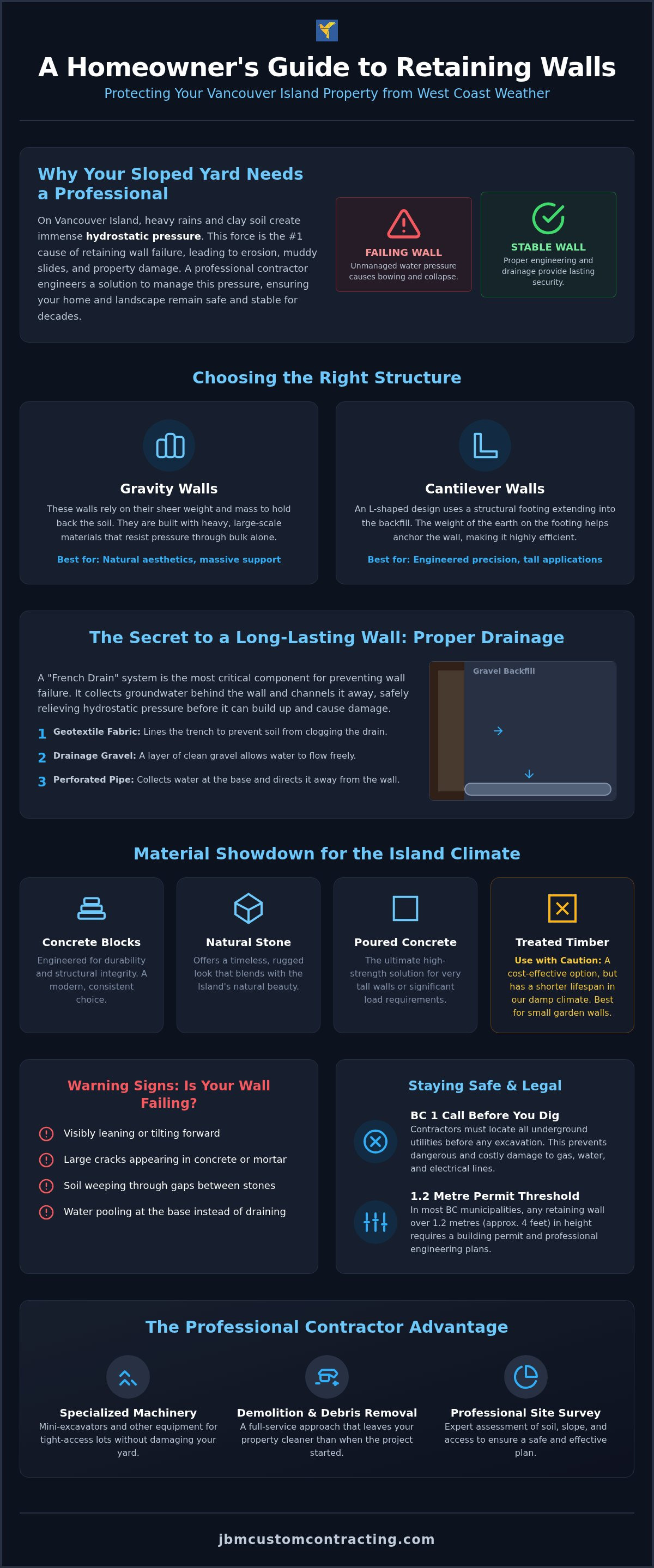
Homeowners generally choose between two main types of walls: gravity and cantilever. Gravity walls rely on their sheer weight and mass to hold back the earth. These are often built with heavy boulders or large concrete blocks. Cantilever walls use a structural footing that extends into the soil, using the weight of the earth itself to help the wall stay upright. Choosing the wrong style for your specific slope can lead to disaster. While a DIY project might seem tempting, the liability risks are significant. A failed wall can cause massive property damage or lead to legal disputes with neighbors if soil spills onto their land. Professional retaining wall contractors have the machinery and experience to prevent these costly errors.
The Role of Engineering and Soil Pressure
Hydrostatic pressure is the leading cause of wall failure on Vancouver Island. When our heavy winter rains saturate the ground, the water trapped behind a wall adds immense weight. If that water has nowhere to go, the pressure will eventually push the wall over. Island slopes require specific calculations for soil load because our unique terrain and clay-heavy ground behave differently than flat, sandy lots. If you are dealing with a structure that is already bowing, you should look into concrete removal services to clear the way for a properly engineered replacement.
When is a Professional Assessment Necessary?
It is time to call in the pros if you notice your current wall is showing signs of distress. You should look for these specific red flags:
- The wall is visibly leaning or tilting forward.
- Large cracks are appearing in the concrete or mortar.
- Soil is "weeping" or washing through the gaps between stones.
- Water is pooling at the base of the wall instead of draining away.
A professional site survey is the best way to ensure safety before construction begins. In communities like Nanaimo or Lantzville, retaining wall contractors must also assess site access. Many Island lots have tight spaces or steep inclines that require specialized, smaller machinery to move materials without damaging the rest of your yard.
Popular Retaining Wall Styles and Materials for Vancouver Island
Selecting the right materials is a balance between your aesthetic goals and the structural demands of our wet climate. Professional retaining wall contractors usually recommend materials based on the specific load-bearing requirements of your lot. The most common choices on the Island include modular concrete blocks, natural stone, pressure-treated timber, and poured concrete. Each material has distinct advantages depending on whether you are prioritizing cost, longevity, or visual appeal.
- Concrete Block Walls: These are a staple for modern builds. They are durable, modular, and offer excellent structural integrity. Because they are engineered to fit together, they provide a consistent level of strength that is easy to calculate for permit purposes.
- Natural Stone and Boulders: If you want your yard to blend with the rugged beauty of the Island, boulder walls are the way to go. They offer a timeless look. They require a skilled operator to place each stone precisely to ensure long-term stability.
- Pressure-Treated Timber: This is a cost-effective option for many homeowners. However, in our damp Pacific Northwest climate, even treated wood has a shorter lifespan than masonry. It is best suited for shorter garden walls rather than major structural slopes.
- Poured Concrete: This is the high-strength solution. It is ideal for very tall walls or areas with significant load requirements, though it requires more intensive formwork and curing time.
Choosing Materials Based on Topography
In areas like Duncan or Cowichan, the slope of your backyard dictates the material choice. Steeper inclines often require the mass of concrete or large boulders to resist soil movement. When considering longevity, concrete wins every time in our damp climate. Wood eventually rots, but concrete remains stable for decades. You can see various material examples through our concrete services Vancouver Island page. Before any digging starts for these heavy materials, always ensure your contractor coordinates with BC 1 Call to locate underground utilities.
Small-Scale and Tight-Access Solutions
Many residential lots in Nanaimo or Parksville have narrow side yards that make traditional construction difficult. This is where small-scale solutions become essential. We use mini-excavators that can fit through narrow passages; this allows us to build in restricted areas without destroying your existing landscaping. Modular blocks are also easier to transport into these restricted spaces compared to massive boulders. JBM takes a custom approach to these difficult layouts. We ensure that even the tightest backyard can benefit from a professional grade wall. If you are dealing with a challenging slope, request a site assessment to see what is possible for your space.
The Critical Role of Drainage in Long-Lasting Retaining Walls
Water is the single greatest threat to structural integrity on the West Coast. While many homeowners focus on the appearance of the stone or block, experienced retaining wall contractors focus on what happens behind the wall. Without a proper drainage system, water builds up in the soil and creates immense hydrostatic pressure. This weight can eventually snap a concrete footing or push heavy blocks out of alignment. A wall that looks solid in July can easily become a liability by November if it hasn't been built to breathe.
To combat this, we use the "French Drain" method as a standard practice. This involves placing a perforated pipe at the base of the wall's interior, surrounded by a thick layer of clear crush gravel. This setup allows water to seep through the gravel and into the pipe, where it is safely diverted away from the structure. In concrete or block walls, we also install "weep holes." These are small gaps that allow any moisture trapped inside the wall itself to escape. At JBM, we don't treat drainage as a last-minute addition. We integrate these systems directly into the foundation to ensure your wall stands firm for decades.
Managing Vancouver Island Rainfall
Communities like Qualicum Beach and Ladysmith are famous for their heavy annual rainfall. When the ground becomes saturated, the soil expands and its "active pressure" against the wall increases significantly. To prevent the drainage system from failing over time, we use high-quality filter fabric. This geotextile layer wraps around the gravel and pipe; it acts as a screen that keeps fine soil particles from clogging the system. Every excavation project requires safety first, so we always recommend checking with BC 1 Call before you dig to ensure no utility lines are disturbed during the install.
The Consequences of Poor Drainage
If a wall was built without these precautions, the signs of failure are usually obvious. You might see bulging blocks, pooling water at the base, or "efflorescence." This is the white, powdery salt stain left behind as water evaporates from the concrete surface. When a wall reaches this point, a simple patch job rarely works. Our demolition services are often the first step in correcting these issues. We remove the failed structure and the saturated soil behind it to start fresh. If you're dealing with a collapsing wall, reading our guide on how to hire a demolition company can help you understand the process of clearing the way for a safer, better-drained replacement.
Planning Your Project: From BC 1 Call to Site Preparation
Successful construction starts long before the first block is placed. Professional retaining wall contractors follow a strict sequence to ensure the site is safe and legal. Skipping these steps can lead to costly fines or dangerous utility strikes. We break the planning phase into four essential steps to keep your project on track and within local regulations.
- Step 1: Utility Locates. You must contact BC 1 Call before any excavation begins. This service is free for homeowners and contractors to request information. It ensures we know exactly where underground gas, water, and electrical lines are buried.
- Step 2: Permit Checks. Local bylaws in Nanaimo and Parksville are specific about wall height. We verify these requirements early to avoid work stoppages and legal issues.
- Step 3: Site Clearing. We remove old structures, overgrown brush, and debris. Our junk removal services ensure the area is clean and ready for the excavation team.
- Step 4: Access Planning. We determine the best path for machinery and material delivery. This is a critical step for steep or narrow Island lots where space is limited.
Navigating Local Permits and Bylaws
The general rule on Vancouver Island is that any wall over 1.2 metres, or approximately 4 feet, requires a building permit. In the City of Nanaimo, walls exceeding this height must be designed and reviewed by a registered professional engineer. This ensures the structure can handle the specific soil loads and hydrostatic pressure of your property. We help you assess if your project hits this threshold; we also coordinate the professional drawings needed for permit approval. Staying within these regulations protects your property value and ensures the wall is legally compliant.
Site Preparation and Property Protection
Heavy equipment can easily damage a well-kept lawn or a paved driveway. We use protective measures like plywood sheeting to create a path for our mini-excavators. This minimizes ground disturbance and keeps your property intact during the build. We also establish a clear staging area for materials. This is where we store clear crush gravel and blocks until they are ready for installation. Proper staging prevents materials from being scattered across your yard, which makes the final cleanup much faster and more efficient.
Schedule a professional site assessment for your project
Why JBM Custom Contracting is the Top Choice for Wall Removal and Construction
Many retaining wall contractors focus solely on the installation of new materials. However; on Vancouver Island, most projects begin with a failing timber or concrete structure that needs to be safely removed first. JBM Custom Contracting offers a "one-stop-shop" advantage by handling both the heavy demolition and the new construction. We don't leave you to find a separate crew to haul away old concrete or rotten wood. Our team manages the entire lifecycle of the project; this ensures a seamless transition from a hazardous slope to a secure, professionally built wall.
Serving Our Island Communities: From Nanaimo to Duncan
Our local roots run deep across Central Vancouver Island. We understand the specific topography of neighborhoods in Lantzville, Cedar, Gabriola Island, and Parksville. Whether you are dealing with the rocky cliffs of North Nanaimo or the heavy clay of the Cowichan Valley, we know how the local soil behaves during our intense rainy seasons. For those planning their budget, we provide small demolitions pricing to ensure transparency before the work begins. Our familiarity with local recycling facilities for old concrete means we handle disposal efficiently and responsibly.
Get Your Professional Wall Assessment Today
Every property has unique challenges that a standard "cookie-cutter" approach cannot solve. When we conduct a site assessment, we look at more than just the wall's location. We evaluate machinery access, the required height for soil stability, and the best material choice for your specific drainage needs. As a custom contractor, we specialize in those tight residential spaces where larger companies often refuse to go. We focus on property maintenance that adds real value to your home while protecting it from the elements. Our goal is to provide a solution that is both functional and aesthetically pleasing. Contact JBM Custom Contracting for a free retaining wall estimate to start securing your property today.
Secure Your Property with a Lasting Solution
Building a wall that stands the test of time on Vancouver Island requires more than just heavy materials; it requires a technical understanding of our local rainfall and soil pressure. You now know that a successful project depends on integrated drainage systems and strict adherence to local permit thresholds. Choosing the right retaining wall contractors means finding a team that handles the messiest parts of the job, from initial demolition to the final site cleanup.
JBM Custom Contracting has served Central Vancouver Island for over a decade with a focus on reliability and precision. We are fully insured and WCB compliant, offering a unique combination of demolition and construction services to streamline your project. We handle the difficult, tight-access jobs that other companies avoid; this ensures your property remains safe and stable for years to come.
Secure your property today! Contact JBM Custom Contracting for a reliable retaining wall quote.
Your backyard should be a place of peace, not a source of worry during the next storm. We look forward to helping you build something strong and dependable for your home.
Frequently Asked Questions
How much do retaining wall contractors typically charge per square foot?
Pricing depends on several variables including material choice, wall height, and site accessibility. Factors like the cost of specialized machinery and material hauling also influence the final estimate. Because every Island lot has a unique slope and soil composition, we recommend a professional site assessment to get an accurate quote for your specific terrain.
Do I need a permit for a retaining wall in Nanaimo or Lantzville?
You generally need a building permit for any wall that exceeds 1.2 metres in height. In the City of Nanaimo, walls over this threshold must be designed and reviewed by a registered professional engineer. It's also important to check local zoning bylaws, as height limits can vary depending on whether the wall is in a front or rear yard.
How long does it take to build a standard residential retaining wall?
Can you remove my old, rotting wood retaining wall before building a new one?
Yes, we specialize in the removal of old or failing structures as part of our full-service approach. Our team handles the demolition of rotting timber and ensures the area is cleared of all old debris. This allows us to start with a clean slate and install a proper drainage system that prevents your new wall from facing the same issues.
What is the best material for a retaining wall on Vancouver Island?
Modular concrete blocks are often the best choice for structural integrity and longevity in our wet Pacific Northwest climate. They don't rot like wood and are much easier to engineer for permit approval than natural stone. However; boulder walls are a fantastic option if you want an aesthetic that blends perfectly with the rugged Island landscape.
Will the heavy equipment damage my existing driveway or garden?
We take specific precautions to protect your property from damage during the construction process. This includes using plywood sheeting to create a path for our mini-excavators; it helps distribute the weight and prevents tracks from ruining your lawn or driveway. Our goal is to ensure your yard remains clean and undamaged once the project is finished.
How do I know if my current retaining wall is failing and needs replacement?
Look for visible red flags such as leaning, large structural cracks, or soil washing through gaps in the wall. You might also notice water pooling at the base or white salt stains on concrete surfaces. These signs indicate that your retaining wall contractors didn't install proper drainage, which is now causing the structure to buckle under pressure.
Does JBM Custom Contracting handle the hauling of old concrete and debris?
We handle the entire hauling and disposal process so you don't have to deal with the mess. Our team removes old concrete, soil, and construction debris; we use local recycling facilities whenever possible. Our no-nonsense approach ensures that your property is left tidy and free of any unwanted materials once the new wall is in place.