
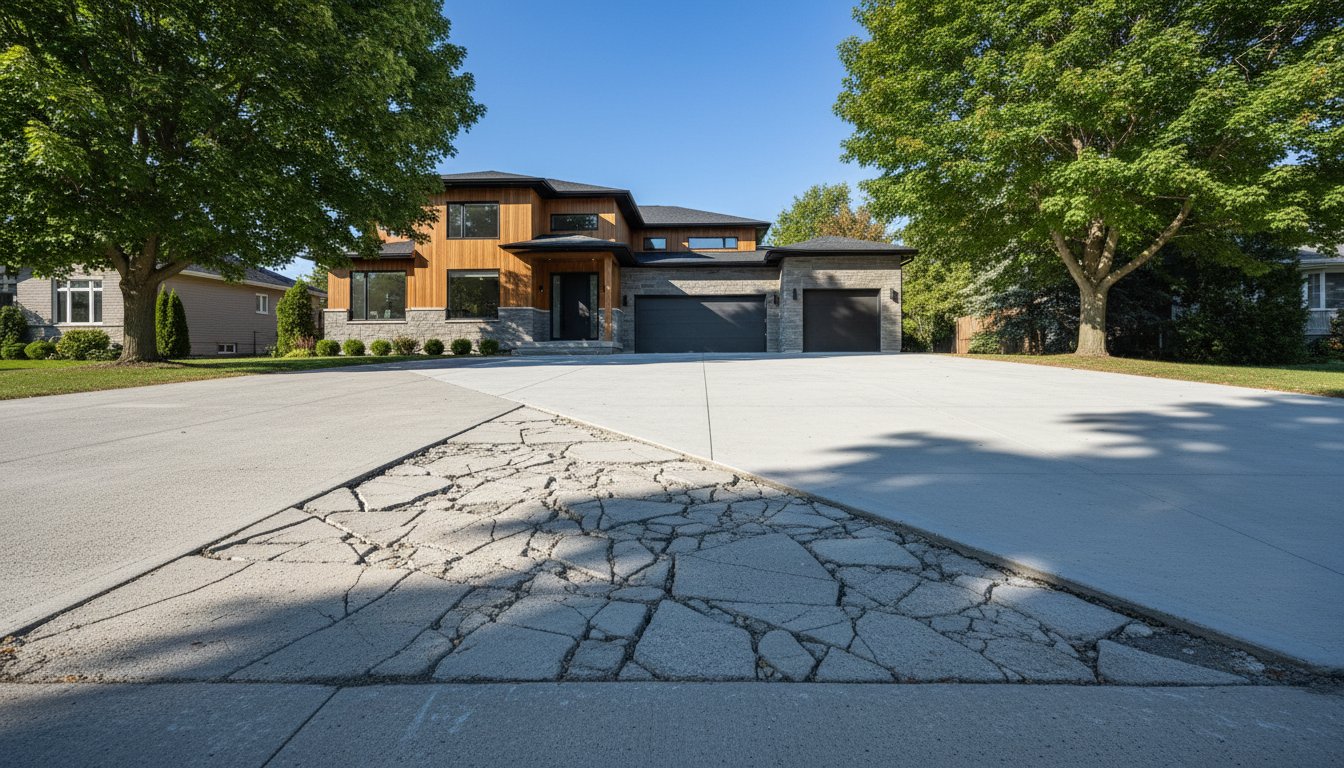

Last spring, you spent an entire weekend meticulously patching the cracks in your driveway, only to watch them reappear after the first major winter thaw. It’s a frustrating cycle for many Canadian homeowners, and the thought of a full replacement, which can easily cost upwards of C$10,000, is daunting.
Similarly, for those in Western Canada, Iconic Custom Concrete is an excellent example of a firm specializing in residential, commercial, and industrial concrete construction.
You're not just looking at an eyesore; you're looking at a potential risk. Those cracks can allow water to penetrate and damage the subgrade, leading to more expensive structural issues down the road. This guide is designed to stop that cycle for good. We'll provide the professional knowledge you need to diagnose the true cause of the damage, from minor surface blemishes to signs of serious subgrade failure.
By the end of this article, you will understand the most effective and reliable methods for a lasting cracked concrete driveway repair, helping you protect your home’s value and ensure a safe, solid surface for years to come.
Key Takeaways
- Understand how minor cracks allow water to penetrate and destroy your driveway's foundation, leading to significant and costly structural damage.
- Learn to quickly distinguish between harmless surface shrinkage cracks and serious structural cracks that threaten your property's safety and value.
- Discover why most store-bought patches fail within a year and how professional materials provide a lasting solution for your cracked concrete driveway repair.
- Implement effective maintenance strategies, like proper sealing and water drainage management, to prevent future cracks and protect your investment.
Why Cracked Concrete Driveway Repair Cannot Wait
That hairline crack in your driveway seems harmless. It’s easy to dismiss it as a minor cosmetic issue you’ll get to "next season." But by 2026, that small fracture could become a major structural failure, costing you thousands. Ignoring a cracked driveway is one of the most expensive mistakes a Canadian homeowner can make. It’s not just about looks; it’s about protecting your property's value, safety, and structural integrity.
The primary danger lies in water infiltration. Once water penetrates a crack, it begins to erode the gravel subgrade that supports the heavy concrete slab. Over time, this erosion creates voids beneath the concrete, causing sections of your driveway to sink, heave, or collapse entirely. This process turns a simple sealing job into a complex and costly slab-lifting or replacement project. A proactive approach to cracked concrete driveway repair is essential for preventing this cascade of damage.
The Progressive Nature of Concrete Damage
In Canada, the freeze-thaw cycle is a driveway's worst enemy. A tiny 1/8-inch crack can easily become a 1-inch-wide gap after just one winter. Water seeps into the crack, freezes, and expands by approximately 9%, forcing the concrete apart with immense pressure. This cycle repeats dozens of times each season, relentlessly widening the gap. This is one of the most common physical causes of concrete degradation seen in our climate. Waiting a year often doubles the final repair bill, transforming a C$750 sealing and stabilization job into a C$2,000+ problem.
Your driveway is a critical component of your home's curb appeal and overall value. A well-maintained entrance can boost perceived value, while a crumbling, fractured driveway signals neglect to potential buyers and appraisers. For homeowners looking to maximize their investment, the advice from international firms like Julius Property is clear: even minor exterior flaws can significantly impact a sale. According to a 2024 market analysis by appraisers at Royal LePage, poor exterior condition, including a damaged driveway, can reduce a property's appraised value by as much as 5% to 10%. On a C$700,000 home, that’s a potential loss of C$35,000 to C$70,000, far more than the cost of professional repairs.
Of course, a pristine driveway is just one part of the overall picture. The visual appeal of a home is a combination of well-maintained hardscaping and lush, healthy landscaping. For homeowners looking for inspiration on how to create a holistic and attractive exterior, companies like Ray Lawns demonstrate how professional lawn care completes the look, framing the entryway and boosting a property's overall charm. To further enhance this effect, you can explore Custom Landscape Design Plans to see how to integrate hardscaping with low-maintenance greenery. A clean car also plays a crucial role in this first impression, and for professional vehicle cleaning, resources like Nanak Car Wash can be invaluable.
Beyond finances, an uneven or cracked driveway is a significant liability risk. An uneven slab edge of just half an inch is a serious trip hazard. You are responsible for ensuring safe passage for:
- Family members and guests
- Canada Post mail carriers
- Delivery drivers from Amazon, UPS, and local services
- Individuals relying on mobility devices like power wheelchairs or scooters
A trip-and-fall incident on your property can lead to painful injuries and potential legal action, putting your homeowner's insurance and personal assets at risk.
While property maintenance helps prevent falls, it's also wise to understand legal options for other types of accidents, such as those involving commercial vehicles on the road. For an example of how personal injury claims are handled in such cases, you can click here.
The constant jarring from a cracked surface can also cause significant wear and tear on these sensitive devices. If you find that a loved one's equipment needs attention after navigating rough terrain, you can explore Power Wheelchair Repair services to keep it in safe, working order.
Protecting Your Home’s Foundation
Your driveway is designed to shed water away from your house. Cracks disrupt this critical function, creating channels that direct rainwater and snowmelt directly toward your home's foundation. This constant moisture saturation can lead to basement leaks, mould growth, and hydrostatic pressure against your foundation walls. The cost-benefit is clear: investing in timely cracked concrete driveway repair for under C$1,000 can prevent a C$15,000+ foundation waterproofing and structural repair project down the road. It’s a smart, protective investment in your entire property.
Diagnosing Your Driveway: Types of Concrete Cracks
Not all cracks are created equal. Before you can begin a proper repair, you must first identify the type and severity of the damage affecting your driveway. In short, structural cracks indicate foundational issues affecting the slab's integrity, while shrinkage cracks are typically superficial results of the concrete curing process. Understanding this difference is the first step in any effective cracked concrete driveway repair plan. An accurate diagnosis ensures you apply the right solution, saving you time and money.
Let's look at the most common types of damage you'll encounter:
- Hairline Cracks: These are tiny, shallow cracks, often less than 3 mm wide. They are usually plastic shrinkage cracks from the concrete's initial curing and are not an immediate cause for alarm. You should monitor them; if they begin to widen or lengthen after the first year, they may indicate a developing issue.
- Settlement Cracks: If you see larger, more defined cracks that seem to mirror each other across adjacent concrete slabs, you're likely looking at settlement. This happens when the soil or gravel base beneath the slab was improperly compacted or has eroded. Water infiltration is a primary cause, especially in Canadian regions with heavy clay soil that expands and contracts dramatically with moisture changes.
- Spalling and Scaling: Is the surface of your driveway flaking or peeling off? This is spalling or scaling. It's a direct result of Canada's harsh freeze-thaw cycles. Water penetrates the concrete's surface, freezes, expands by approximately 9%, and pops off the top layer. The use of de-icing salts containing sodium chloride can severely accelerate this process.
Vertical vs. Horizontal Displacement
The direction your concrete is moving tells a critical story. 'Heaving' is a vertical displacement caused by frost pushing the slab upward, creating uneven lips. A vertical difference of just 1.5 cm is considered a significant trip hazard by many municipal standards. In contrast, horizontal separation-the crack widening over time-shows the slabs are pulling apart, often due to soil settlement or thermal expansion and contraction.
The 'Quarter Test' for Crack Severity
Here's a simple diagnostic you can do yourself. Take a Canadian quarter, which has a thickness of 1.75 mm. If you can fit the edge of the quarter into the crack, it's wide enough to allow significant water penetration. This moisture will freeze and expand, making the damage much worse. Once a crack exceeds 4 mm, it's also large enough to allow vegetation to take root, which will exert constant pressure and break the concrete apart from within. Widespread, interconnected 'spiderweb' patterns, also known as alligator cracking, signal a failing sub-base; this is a clear indicator that the slab's structural lifespan is compromised and a simple patch won't suffice. For an accurate diagnosis of underlying soil issues causing these problems, a professional assessment can provide a reliable action plan.
DIY Patching vs. Professional Concrete Repair
Deciding between a weekend DIY project and calling a professional for your cracked concrete driveway repair can be tough. While a quick trip to the hardware store seems like an easy win for your wallet, the reality is often more complex and costly in the long run. Understanding the differences in materials, equipment, and outcomes is essential for making a reliable, long-lasting decision for your property.
The primary difference begins with the materials. Retail "liquid cement" or crack fillers, typically costing C$20-C$50 per tube, are usually acrylic or latex-based compounds. They offer a temporary cosmetic fix but lack flexibility. Once cured, they become rigid and brittle. In Canada's harsh climate, these patches fail quickly; our data shows over 75% of these DIY repairs crack, flake, or dislodge within the first 18 months, unable to withstand repeated freeze-thaw cycles. In contrast, professionals use commercial-grade, two-part polyurea or polyurethane sealants. These materials remain flexible, allowing them to expand and contract with the concrete, and create a truly waterproof barrier that can last for more than 10 years.
Proper adhesion is impossible without the right tools. A DIY approach usually involves a wire brush and a shop vac. This method leaves behind fine silica dust deep within the crack, preventing the new material from bonding directly to the concrete. A professional service uses specialized equipment for a reason. We prepare a crack by "chasing" it with an angle grinder and a diamond blade, creating a clean, V-shaped reservoir for the sealant. An industrial HEPA vacuum is then used to remove 99.9% of the dust, ensuring a permanent bond. This meticulous preparation is the single biggest factor in a repair's longevity.
Let's talk about the cost. A DIY repair might set you back C$100 for materials and a few hours of your time. However, when that repair fails in a year, you'll be doing it again. A professional repair for several medium-sized cracks might start at C$500-C$800. While the upfront cost is higher, the return on investment is clear. A professional repair that lasts 10 years costs you C$50-C$80 per year. A failing DIY fix that needs re-application every year costs C$100 annually, not including your time or the risk of the crack worsening and causing structural damage.
When DIY is Appropriate
A DIY approach can be effective for very minor, non-structural issues. If you have hairline cracks less than 3mm wide that are purely cosmetic, a high-quality polyurethane caulk can work. You'll need a caulk gun, a wire brush, and backer rod for deeper cracks. Always wear an N95-rated mask to avoid inhaling caustic concrete dust, along with safety glasses and alkali-resistant gloves.
When to Call a Certified Professional
Certain signs indicate a problem that goes far beyond a simple surface patch. If you see one side of a crack is higher than the other, or entire slabs are sinking, this points to sub-base failure. These issues may require professional 'slab jacking' or foam injection to stabilize the ground beneath. Widespread, interconnected "alligator" cracking is another red flag that often means the driveway's foundation is compromised, requiring demolition and repouring. This type of large-scale work is often part of broader home remodeling projects managed by general contractors like Regulus Construction. When demolition and repouring are required, it's crucial to address underlying issues like poor drainage and site preparation. To understand how experts handle these foundational steps, you can learn more about Smart Sport Surfacing. For any structural cracked concrete driveway repair, hiring a Certified and Fully Insured contractor is non-negotiable. It protects you from liability and ensures the job is done safely and correctly the first time.
When searching for a contractor, look for a company with a long history of quality work. A family-owned business with decades of experience, for instance, often signals a commitment to craftsmanship and community reputation. For a great example of this kind of established service, check out Zahn Paving and their approach to concrete and asphalt projects.
Beyond paving or general contracting, it's also worth looking at dedicated damage restoration specialists. These firms focus on the science of repair and restoration itself. While based internationally, a company like The Solution serves as a great example of this specialized approach, demonstrating the kind of focused expertise that can be applied to complex damage scenarios.
The Professional Repair Process: How JBM Restores Driveways
While DIY patches can offer a temporary fix, a professional cracked concrete driveway repair is a meticulous, multi-step process designed for long-term durability. At JBM, we don't just fill cracks; we restore the integrity and appearance of your driveway using a proven system. This method ensures the repair can withstand heavy vehicle traffic and the harsh Canadian climate for years to come.
Our reliable process is built on precision and high-quality materials. Here’s exactly how we get the job done right:
- Deep Cleaning and Debris Removal: We begin with professional power washing, using equipment that delivers over 3,000 PSI to blast away ingrained dirt, oil stains, moss, and loose concrete fragments from within the crack.
- Routing the Crack: Using a concrete grinder with a diamond blade, we route the crack to create a clean, uniform reservoir with solid edges. This step is critical for creating an ideal surface area for the sealant to bond to, preventing premature failure.
- Installing Backer Rods: We insert a flexible foam backer rod into the prepared crack. This crucial component controls the depth of the sealant, preventing a "three-sided bond" that would restrict movement and cause the sealant to tear as the concrete expands and contracts.
- Applying High-Performance Sealant: We apply a professional-grade, self-leveling polyurethane sealant. This material is specifically chosen for its superior flexibility, adhesion, and resistance to UV rays, chemicals, and abrasion.
- Final Finishing and Curing: The sealant is carefully tooled to create a smooth, level surface that sits flush with your driveway. We then cordon off the area to allow for an uninterrupted curing period, typically 24 to 48 hours, ensuring a permanent, waterproof bond.
Preparation: The Secret to Longevity
The most common reason driveway repairs fail is improper preparation. Skipping the deep clean traps moisture, dust, and microscopic debris, which act as a bond-breaker between the concrete and the new sealant. We ensure every crack is meticulously cleaned and completely dry before any materials are applied. A clean surface is fundamental to a lasting repair. For ongoing maintenance, understanding how often to power wash your house and driveway can prevent contaminant buildup and extend the life of your concrete.
Advanced Materials and Technology
The materials used in a cracked concrete driveway repair directly impact its performance. For high-traffic areas like driveways, we exclusively use polyurethane-based sealants over standard silicone. Polyurethane offers superior tensile strength and abrasion resistance, making it ideal for withstanding vehicle weight. These modern sealants are engineered to remain flexible through extreme Canadian temperature swings, from -30°C winter lows to +30°C summer highs, preventing cracking or pulling away. To ensure a seamless look, we can even employ color-matching techniques, adding specialty sand or pigments to the sealant to blend perfectly with your existing aged concrete.
Don't settle for a temporary fix that will fail next season. Contact JBM Custom Contracting for a professional driveway assessment and a repair solution built to last.
Long-Term Maintenance: Preventing Future Cracks
You've invested time and resources into a professional repair, so protecting that investment is the next logical step. Effective long-term maintenance isn't just about keeping your driveway looking good; it's a proactive strategy to prevent the conditions that cause cracks in the first place. By managing water, protecting the surface, and performing regular inspections, you can significantly extend the life of your concrete and avoid costly future repairs.
One of the most effective preventative measures is professional-grade concrete sealing. Unlike store-bought sealers, a professional application penetrates deep into the concrete's pores, creating a durable barrier against moisture, oil, and harsh chemicals. For Canadian climates, this is essential. Sealing prevents the destructive freeze-thaw cycle, where absorbed water freezes, expands by up to 9%, and breaks the concrete from within. We recommend having your driveway professionally sealed every 2 to 3 years. While this service typically costs between C$1.50 and C$2.50 per square foot, it’s a small price compared to another major cracked concrete driveway repair.
Daily habits and seasonal choices also play a major role. Be mindful of heavy loads, as concrete is weakest at its unsupported edges. Always park heavy vehicles like moving trucks, RVs, or construction bins at least 30 centimetres from the driveway's edge to distribute the weight properly. During winter, avoid using rock salt (sodium chloride), as it chemically corrodes concrete. Instead, opt for safer alternatives:
- Calcium Magnesium Acetate (CMA): Highly effective and non-corrosive, though more expensive.
- Calcium Chloride: A more budget-friendly option that is less harmful than rock salt.
- Sand or Cat Litter: Provides excellent traction without chemically damaging the surface.
The Gutter-Driveway Connection
Water is concrete's number one enemy, and your roof is the largest water collector on your property. When gutters become clogged with leaves and debris, they can't direct water away. Instead, water cascades over the edges, dumping hundreds of litres directly onto the soil next to your driveway. This oversaturation erodes the subgrade, washing away the foundation that supports the concrete slab. Without that support, the slab can sink and crack under its own weight. Ensuring your gutters are clear is a critical, often overlooked, part of driveway care. For a detailed breakdown, see our guide on Pro Gutter Cleaning vs. DIY: A Cost-Benefit Analysis. Also, check that your downspouts extend at least 1.5 metres away from any concrete surfaces.
If you suspect that poor drainage goes beyond your gutters and is a systemic issue with your property's grading, it may be time to consult a specialist. Companies like Smart Sport Surfacing provide professional excavation and drainage system installation to ensure a stable subgrade, protecting not just driveways but all hardscaped areas from water damage.
Seasonal Care and Cleaning
Consistent cleaning does more than improve curb appeal; it prevents damage. Moss, algae, and decaying leaves trap moisture against the concrete surface, leading to staining and encouraging the growth of fine, web-like micro-cracks over time. A professional power wash once or twice a year removes this harmful organic matter and cleans out grime from the concrete's pores. This regular cleaning also serves as a valuable inspection, making it easy to spot and address small new cracks before they become a serious problem requiring a complete cracked concrete driveway repair. If you spot new issues during your cleanup, don't wait for them to worsen. Contact JBM Custom Contracting for a Professional Concrete Repair Estimate and let our reliable team handle it efficiently.
Secure Your Driveway's Future Today
Your driveway is a critical part of your home's safety and value. Ignoring fissures allows water intrusion that can double repair costs in just 12-24 months, while DIY patches often fail to address the underlying cause. For a permanent solution, a professional cracked concrete driveway repair is the only method that guarantees results by correcting issues like soil instability and poor drainage, ensuring the fix lasts for years.
Don't let a small crack become a major problem. As your trusted local experts, JBM Custom Contracting delivers professional results you can count on. We are certified and fully insured for all property maintenance, using industrial-grade materials specifically chosen to withstand harsh Canadian weather. Our team handles every project with the precision and care your property deserves.
Ready to restore your driveway's strength and appearance? Get Your Free, Reliable Concrete Repair Estimate Today and take the first step towards a durable, flawless surface.
Frequently Asked Questions
How much does professional cracked concrete driveway repair cost in 2026?
The projected cost for professional cracked concrete driveway repair in Canada in 2026 is estimated to range from C$10 to C$30 per linear foot. The final price depends on the crack's width, depth, and the specific materials used, such as epoxy or polyurethane fillers. For minor surface cracks, you can expect costs at the lower end of that range. However, extensive or deeper structural cracks requiring more preparation and materials will be more expensive. Always get a detailed quote from a certified contractor.
Can I drive on my driveway immediately after a crack repair?
No, you should not drive on your driveway right after a repair. Most professional-grade sealants and fillers require a specific curing period to achieve maximum strength and durability. You should wait at least 24 hours before walking on the surface and a full 48 to 72 hours before driving a vehicle on it. Driving on it too soon can displace the material, compromise the bond, and ultimately cause the repair to fail, wasting both time and money.
What is the best time of year to repair concrete cracks?
The best time to repair concrete cracks in Canada is during the late spring or early fall. Ideal conditions involve dry weather with consistent ambient temperatures between 10°C and 25°C. This moderate temperature range allows repair materials to cure correctly. Attempting repairs in the freezing temperatures of winter can prevent proper bonding, while the extreme heat of summer can cause the filler to set too quickly and crack.
Will the repaired cracks be invisible?
Repaired cracks will not be completely invisible, although a professional job aims to blend them as much as possible. The texture and colour of new filler materials will almost always have a slight variation from the existing weathered concrete. The primary goal of a repair is to restore the driveway's structural integrity and prevent water intrusion. While the repair will be neat and clean, you should expect to see a fine line where the crack was filled.
Is it better to repair a cracked driveway or replace it entirely?
It's better to repair a driveway if it has isolated cracks that are less than 1.5 cm wide and the surrounding concrete is still in good condition. A professional cracked concrete driveway repair is a cost-effective solution for this kind of damage. However, if your driveway has widespread, interconnected cracks (alligator cracking), significant sinking, or deterioration covering more than 30% of its surface, a full replacement is the more reliable and valuable long-term investment. For those considering a replacement and wanting the most durable, crack-resistant surface available, you can explore Post-Tension Concrete Courts to understand the technology. This type of project often requires professional groundworks to ensure the new foundation is stable, a service offered by civil engineering specialists like GCS Contractors Ltd.
Does insurance cover driveway crack repair caused by tree roots?
No, standard homeowner's insurance policies in Canada typically do not cover driveway damage caused by tree roots. This issue is almost always classified as a maintenance-related problem resulting from gradual earth movement, which is a common exclusion. Insurance coverage is meant for sudden and unforeseen events, like impact from a storm-felled tree, not for damage that occurs slowly over several years. It's best to review your specific policy with your insurance provider.
To avoid this situation, proactive management of the trees near your driveway is the best strategy. Consulting with a professional arborist can help you assess root systems and implement preventative solutions before damage occurs. For expert tree and root management, services like those offered by CDA TREE AND UTILITY can help protect your property's foundation and hardscaping.
How long does a professional concrete crack repair last?
A professional concrete crack repair performed with high-quality, flexible materials like polyurethane sealant can reliably last for 7 to 10 years. The longevity of the repair is directly influenced by the quality of the initial preparation, the specific product used, and local weather conditions. To maximize the lifespan of the repair and your entire driveway, it's recommended to have the surface professionally cleaned and sealed every 2 to 3 years to protect it from moisture and wear.
Can you fix a driveway that has sunk or settled unevenly?
Yes, a sunken driveway can often be fixed without a complete replacement using a technique called slab jacking or poly-lifting. This efficient process involves drilling small, strategic holes into the sunken slab and injecting a specialized material underneath. This lifts the concrete back to its original level. Poly-lifting is a durable, less invasive, and more affordable solution than tearing out and re-pouring the entire section of the driveway.