

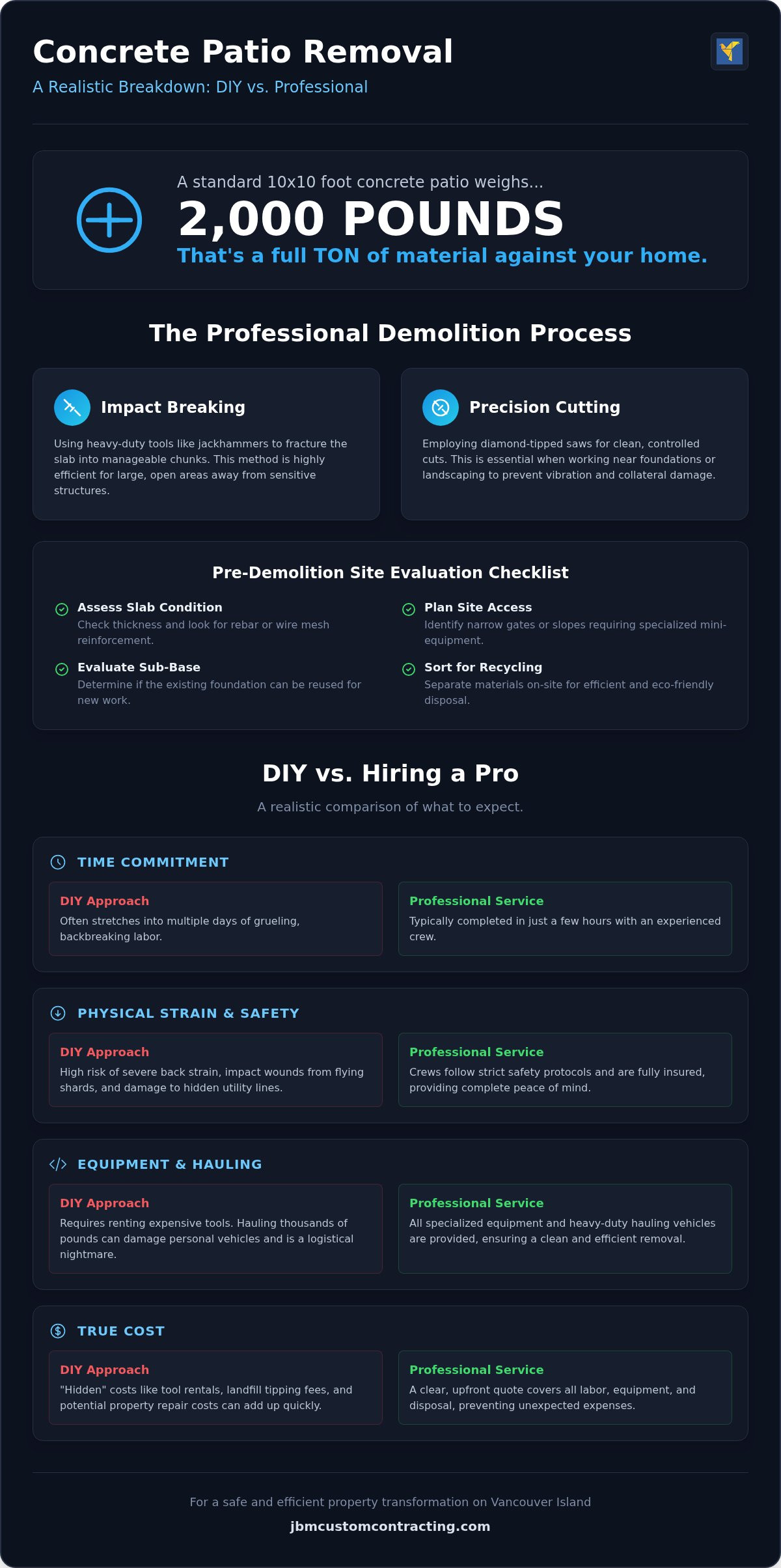
Did you know that a standard 10-by-10-foot concrete patio weighs approximately 2,000 pounds? That is a full ton of solid material sitting right against your home's exterior. It's understandable if the thought of tackling a concrete patio removal project feels overwhelming, especially when you consider the physical intensity and the risk of accidentally damaging your foundation. You aren't alone in feeling confused about the latest disposal rules in the Regional District of Nanaimo, or navigating other local regulations for concrete patio removal.
We agree that your property deserves a fresh start without the backbreaking labor or the stress of logistics. This guide provides the most efficient ways to clear your space and prepare your Vancouver Island property for a professional renovation. You'll discover the specific steps for safe demolition, a breakdown of local 2026 tipping fees, and clear advice on when to handle the work yourself versus when to hire a dependable crew to get the job done right.
What Does Professional Concrete Patio Removal Involve?
Professional concrete patio removal is the systematic breaking, prying, and hauling of heavy slabs and footings. It isn't just about swinging a sledgehammer; it's a controlled process designed to clear space for your next renovation project. While some might view demolition as simple brute force, residential spaces require a more nuanced approach. We focus on protecting your home's foundation and ensuring underground utilities, like water or gas lines, remain completely undisturbed during the process.
For most homeowners on Vancouver Island, the goal of concrete patio removal is to transition from an old, cracked surface to a modern outdoor living area. Achieving this requires a clear understanding of the difference between total demolition and selective demolition. A surgical approach prevents collateral damage to your siding, landscaping, or nearby structures, saving you time and money on avoidable repairs later.
To better understand this concept, watch this helpful video:
Breaking vs. Precision Cutting
The method used often depends on how close the concrete sits to your house. Breaking involves using heavy-duty impact tools, such as electric or hydraulic jackhammers, to fracture the slab into manageable chunks for hauling. This is efficient for large, open areas. However, when working right against a foundation or a delicate garden wall, precision cutting with diamond-tipped saws is necessary. This ensures clean edges and prevents vibrations from traveling into the home's structure. Selective demolition is the surgical removal of specific sections without harming adjacent structures.
Site Preparation and Evaluation
Before any tools start moving, a thorough evaluation is essential. We assess the thickness of the slab and check for the presence of rebar or wire mesh, which affects how the material breaks and how it must be disposed of. Many Vancouver Island backyards have "hard access" points, such as narrow side gates or steep slopes. These areas require specialized mini-equipment that can navigate tight spaces without destroying your lawn. We also evaluate the existing sub-base to see if it can be reused for new concrete work. Proper sorting at this stage also allows for more effective Concrete recycling methods, turning your old patio into useful aggregate for future construction projects.
DIY vs. Hiring a Pro: A Realistic Comparison
Many homeowners consider tackling a concrete patio removal themselves to save money. On paper, it looks like a straightforward weekend task. However, the reality of manual demolition involves significant physical strain and logistical hurdles that often outweigh the initial savings. Swinging a heavy sledgehammer for hours on a standard 10x10 patio is exhausting work that can lead to injury if you aren't used to it. While a professional team can often complete the job in a few hours, a DIY approach frequently stretches into multiple days of grueling, backbreaking labor.
The True Weight of the Project
It's hard to visualize the massive weight of a patio until you start breaking it apart and trying to move it. A single cubic yard of concrete weighs roughly 4,000 lbs. If you're working on a standard slab, you're dealing with thousands of pounds of heavy, jagged aggregate. Loading this material into a personal truck is a logistical nightmare that can easily damage your vehicle's suspension or scratch the bed.
Professional junk removal services streamline this entire process by providing the right equipment to haul away heavy debris in a single trip. Beyond the hauling, you also have to navigate local concrete disposal options to ensure the material is recycled correctly according to Vancouver Island regulations. When you factor in the cost of tool rentals, such as electric jackhammers, and landfill tipping fees, the "hidden" costs of a DIY project can add up much faster than expected.
Safety Risks and Property Protection
Safety is the most critical factor to consider before you pick up a tool. Common DIY injuries include severe back strain, impact wounds from flying concrete shards, and even long-term vibration-related issues from using a jackhammer without proper experience. Professionals prioritize safety protocols and carry comprehensive insurance. This provides essential peace of mind, especially when your project requires working near sensitive underground gas lines or water mains that could be easily damaged by an amateur mistake.
Protecting your surrounding property is another area where experience matters. Heavy machinery or even falling chunks of concrete can easily ruin a healthy lawn or crack a nearby driveway. Pros use specialized plywood paths and low-impact equipment to move debris without leaving a trace. If you're ready to clear your yard for a fresh start, requesting a professional assessment for your demolition needs ensures the job is handled safely, efficiently, and without the mess.
The Tools of the Trade: How Pros Break the Heavy Stuff
Successful concrete patio removal requires more than just physical strength; it relies on the right mechanical advantage. Professionals use a specific arsenal of tools to ensure the job is done without damaging the surrounding property. While a sledgehammer might work for a thin sidewalk, a standard patio often requires heavy-duty intervention to handle reinforced materials and thick slabs efficiently.
- Jackhammers: These are essential for precision work in tight corners or near walls where larger machines can't operate safely.
- Skid Steers and Mini-Excavators: These machines are the primary workhorses for lifting heavy slabs and loading them for hauling.
- Hydraulic Breakers: These are high-power attachments that fit onto excavators to crush reinforced concrete and make short work of stubborn footings.
- Concrete Saws: Diamond-blade saws create clean break-lines. This prevents "over-break" and protects the structural integrity of adjacent stairs or foundations.
By using these advanced tools, demolition services can complete in a few hours what would take a homeowner days of manual labor. This mechanical approach also ensures the site is left clean and ready for the next phase of your project.
Mini-Equipment for Tight Backyard Access
Backyards in Nanaimo or Lantzville often present unique challenges like narrow side-yards and established gardens. Mini-excavators are the perfect solution for these residential spaces. These machines are narrow enough to maneuver through standard gates, which means we don't have to remove fence panels or disturb your landscaping. They provide the power of a full-sized machine in a compact frame. To see how this works in a real backyard, you can find videos online showing a mini-excavator with a breaker attachment in action.
Managing Dust and Neighborhood Disruptions
Demolition is naturally noisy and dusty, but professional teams take steps to minimize the impact on your home and neighbors. We use active dust suppression techniques, such as water spray, to keep particles from drifting into your house or the neighbor's yard. Vibration control is also a top priority. By using precision tools like concrete saws first, we isolate the impact shock and protect your home's foundation from damage. If you live in a quiet community like Parksville or Qualicum Beach, we recommend a courtesy notification to neighbors so they know what to expect during the few hours of active concrete patio removal work.
Logistics, Disposal, and Recycling on Vancouver Island
Handling the debris from a concrete patio removal is often the most complex part of the project for Vancouver Island homeowners. Most local landfills, including facilities in the Regional District of Nanaimo and the Comox Valley, have strict regulations regarding heavy construction waste. As of late 2026, tipping fees for mixed construction waste can exceed $200 per tonne. However, clean, sorted rubble is often accepted at a much lower rate, sometimes as low as $60 per tonne at facilities like the Comox Valley Waste Management Centre. This price difference creates a strong financial incentive to keep concrete separate from other household trash.
Choosing a contractor who understands these local sorting rules isn't just about saving money; it's about environmental responsibility. Old patio slabs don't belong in a landfill where they'll sit forever. Instead, they're transported to recycling centers near Nanaimo where they're crushed into high-quality aggregate. This recycled material becomes the foundation for new road bases and local infrastructure projects, giving your old backyard surface a second life. It's a sustainable cycle that keeps heavy materials out of our shared Island waste streams.
Local Hauling Norms: Nanaimo to Duncan
Moving tons of concrete requires more than a standard pickup truck. In residential areas from Nanaimo to Duncan, we typically use specialized bin services or maneuverable dump trucks. Navigating the narrow, winding roads and steep driveways common on the Island takes precision. Our team ensures that every piece of debris is cleared, leaving you with a "ready-to-build" site. We focus on a "clean as you go" philosophy, which means your driveway and lawn won't be left with a mess of dust and gravel once the heavy hauling is finished. To help visualize the possibilities for your newly cleared space, you can discover Bayside Pavers and explore their portfolio of high-end hardscaping and paver installations.
Once the concrete is gone, the real work of site preparation begins. This is the perfect time to address your yard care needs and evaluate the exposed ground. We carefully grade and level the soil to ensure proper water runoff. It's common to find drainage issues that the old patio was hiding, such as pooled water near the house or soft spots in the dirt. Fixing these problems now prevents your next renovation from sinking or cracking. By ensuring a solid, compacted sub-base, we provide the stable ground needed for a successful new patio or deck installation.
Request a professional hauling assessment for your project.
JBM Custom Contracting: Reliable Demolition from Lantzville to Duncan
JBM Custom Contracting provides a no-nonsense approach to residential and small commercial demolition. We understand that your home is your biggest investment. Therefore, we prioritize safety and precision in every project. Our team is fully insured and certified, offering homeowners total peace of mind throughout the entire process. Whether you're in Nanaimo, Cedar, or Ladysmith, we handle the heavy lifting so you don't have to. We take pride in being the reliable choice for homeowners across the Cowichan Valley. Our reputation is built on hard work and the ability to handle difficult jobs correctly and without unnecessary hassle.
Your Local Vancouver Island Experts
Our deep knowledge of Vancouver Island terrain allows us to navigate unique property layouts with ease. We offer fast, responsive service for property owners in places like Gabriola Island and Parksville. We don't just break concrete; we understand how the local climate and soil conditions affect your foundation. This expertise is vital for a successful concrete patio removal. We're familiar with the specific challenges of Island properties, from steep slopes to rocky sub-bases. You can book a professional assessment for your patio removal to get started on your project today.
Complete Property Solutions
We specialize in bridging the gap between old structures and new dreams. Our team doesn't just leave a pile of rubble. We provide a clean site ready for full-service renovations. You'll find transparent information regarding small demolitions pricing on our website. This ensures there are no surprises when the bill arrives. Our "clean as you go" philosophy is what truly sets us apart from the competition. We treat your property with the respect it deserves. This means we clear every piece of debris so your yard is ready for the next phase immediately. Choosing us for your concrete patio removal means you get a reliable start to your renovation with a team that values operational excellence and safety. We're ready to help you transform your property from Lantzville to Duncan.
Start Your Next Renovation on a Solid Foundation
Taking the first step toward a property renovation means making a clean break from the past. A professional concrete patio removal ensures that your home's foundation remains protected while the heavy, backbreaking work of demolition is handled with precision. By choosing a team that understands local recycling regulations and employs the right mini-equipment, you skip the logistical stress and the physical toll of a DIY project.
Our team specializes in small demolitions, providing the surgical precision needed for residential backyards. We're fully insured and certified, serving homeowners from Nanaimo to Duncan with a commitment to leaving every job site spotless. Whether you're planning a new deck, a modern stone patio, or a lush green lawn, starting with a clear and level foundation is essential. We're ready to help you transition safely and efficiently to your next project.
Request Your Free Concrete Demolition Quote
Your dream outdoor space is just one clean slate away. We look forward to helping you build something great on your Vancouver Island property.
Frequently Asked Questions
How much does concrete patio removal cost on Vancouver Island?
Factors include slab thickness and the presence of reinforcement like rebar. While general 2026 estimates for demolition range from $2 to $6 per square foot, local disposal fees also play a significant role in the final investment. For example, rubble tipping fees at Comox Strathcona facilities are $60 per tonne. We recommend a professional assessment to determine the specific weight of your old slab and the logistics required for hauling.
Do I need a permit to remove a concrete patio in Nanaimo?
No, a separate demolition permit is typically not required for removing non-structural elements like patios in Nanaimo. The City of Nanaimo has confirmed this regulation. If your concrete patio removal is part of a larger construction project, the work is usually covered under your main building permit. It's always a good idea to verify with your local planning department if you're adding a new structural addition.
Will the heavy equipment damage my lawn or existing landscaping?
We use specialized mini-equipment and protective measures to keep your landscaping intact. Mini-excavators are designed to exert low ground pressure, which helps prevent ruts in your grass. We also lay down plywood paths to create a stable surface for moving heavy debris across your lawn. This "clean as you go" philosophy ensures your yard in Parksville or Qualicum Beach remains in excellent condition throughout the entire demolition process.
How long does it typically take to remove a standard backyard patio?
Most standard residential concrete patio removal projects are completed in a single day. A professional crew can break, lift, and haul away a typical 10x10 slab in just a few hours. This is much faster than manual DIY methods, which often take several days of backbreaking labor. We arrive with the right machinery to ensure your property is clear, level, and ready for the next renovation phase as quickly as possible.
What happens to the concrete after you haul it away?
Your old concrete is transported to local recycling facilities near Nanaimo to be repurposed. It doesn't sit in a landfill. Instead, it's crushed into high-quality road base aggregate. This recycled material is used for new infrastructure projects across Vancouver Island. Choosing a contractor who prioritizes recycling helps divert heavy waste from our regional landfills and supports a more sustainable construction cycle for all residents in our community.
Can you remove a patio that is reinforced with rebar or wire mesh?
Yes, we have the specialized hydraulic breakers and diamond-tipped saws needed to handle reinforced concrete. Rebar or wire mesh makes manual demolition nearly impossible, but our machinery cuts through these materials efficiently. Proper sorting of reinforced concrete is also important for disposal and recycling. We handle the entire process, from the initial precision cuts to the final hauling of the metal-reinforced debris from your Island property.
Is the demolition process very loud for my neighbours?
Demolition is a noisy process, but we take steps to minimize the disruption for your neighbors. The most intense noise usually lasts only a few hours while we use hydraulic breakers. We use precision cutting saws to isolate vibrations, which protects your home's foundation and reduces impact shock. If you live in a quiet area like Lantzville or Cedar, we suggest notifying neighbors a day in advance as a courtesy.
Can you work in tight spaces behind my house or fence?
We specialize in small demolitions that require navigating narrow access points. Our mini-excavators and skid steers are narrow enough to fit through standard backyard gates without removing fence panels. This makes us the ideal choice for established neighborhoods in Duncan or Cedar where space is limited. We can safely maneuver behind your house to remove old concrete without disturbing your existing gardens, porch structures, or other landscaping features.