

The most powerful tool isn’t always the right one for breaking up concrete. A demolition hammer can make quick work of a small slab, but reinforced concrete, tight access or nearby structures may call for a more controlled approach. Choosing among concrete removal tools and techniques starts with the material and the site, not just the equipment’s strength.
It can be hard to tell how thick a slab is or whether it contains reinforcing steel, especially when you need to protect nearby surfaces or account for buried services. This guide compares what hand tools, demolition hammers, saws and larger equipment can do, and explains how thickness, reinforcement, access and cleanup affect your options. For substantial concrete or complex site conditions, JBM Custom Contracting provides concrete work and small demolition services for homes and businesses across its Vancouver Island service area, including Nanaimo, Lantzville, Duncan, Ladysmith, Cedar, Parksville, Qualicum Beach, Cowichan and Gabriola Island.
Concrete Removal Tools and Techniques: What Determines the Right Method?
Concrete removal means breaking, cutting or lifting concrete to make way for a repair, replacement or site change. The area alone doesn’t determine the right approach. A small reinforced step beside a wall may need more care than a larger, unreinforced slab in an open space. The material, the finish you want and the room available to work all matter.
Before choosing among concrete removal tools and techniques, consider how much control the job requires, what may be inside the concrete and what needs protection nearby. A visual check can help with planning, but it can’t reveal every hidden condition.
This video shows formwork being stripped from a concrete column. That’s different from breaking out hardened concrete, but it’s a useful example of how the task determines the tools.
Let the concrete and the site conditions guide the method, not tool power alone. A demolition hammer may break up a straightforward section, while a saw can create a cleaner edge before removal. Larger equipment can move substantial pieces, but it needs enough access and working room to avoid nearby features.
What should you assess before choosing a concrete removal method?
Identify what you’re removing: a slab, walkway, patio, step or another feature. Note visible thickness, cracks and exposed metal, but treat them as clues rather than proof of what lies beneath. Then map walls, landscaping, adjacent paving and any known or suspected buried services. Mark what must stay intact, and plan how broken concrete will leave the site. Clearing other unwanted material can also keep the work area accessible. JBM offers junk removal services.
- Access: Is there a clear route for workers, tools and debris?
- Precision: Does the edge need to stay clean beside a surface you’re keeping?
- Protection: Which nearby structures, surfaces or plants could be affected?
Why are concrete thickness and reinforcement important?
Thicker concrete can take more effort to break or cut. Reinforcement can hold broken sections together and change how they separate and are handled. Rebar is steel embedded in concrete to reinforce it. Its presence may affect the removal sequence and equipment needed, so a slab that looks simple from above may still require staged work.
Cracks or visible metal can offer clues, but the surface doesn’t show the full depth, reinforcement pattern or condition. A closer assessment helps establish what the work involves before you choose a method. For larger or reinforced sections, professional planning can account for site constraints and nearby property. Techniques such as Hydrodemolition use high-pressure water to remove concrete in specific applications, including around embedded metal. It isn’t a default choice for every property project.
Common Concrete Removal Tools: What Each One Can, and Cannot, Do
A tool’s usefulness depends on more than how forcefully it breaks concrete. For a residential job, consider the section’s size and thickness, how close it is to something you want to keep, how much working room is available and how the broken pieces will be moved. The right choice balances breaking power with control and cleanup.
Use this comparison to narrow down the options:
| Tool | Good fit | Control and access | Debris and limitations |
|---|---|---|---|
| Hand tools, such as a sledgehammer and pry bar | Small, accessible areas or limited breakout work | Direct control, but space is needed to swing and reposition tools | Creates loose fragments; slow and physically demanding for larger areas |
| Demolition hammer | Breaking a manageable slab or section | Handheld, but needs steady handling and room to work | Breaks concrete into pieces; reinforcement can complicate separation |
| Concrete saw | Defining an edge or separating a planned section | Useful where a more controlled cut is needed | Makes cuts, but doesn’t lift or remove the section on its own |
| Breaker or larger equipment | Larger, thicker or demanding removal work | Needs suitable access and room to position and operate equipment | Can create substantial debris that still needs to be handled and cleared |
When do hand tools or a demolition hammer make sense?
Hand tools can suit a small, reachable area where gradual work and control matter more than speed. A sledgehammer breaks concrete; a pry bar can help shift pieces once they’ve loosened. A demolition hammer delivers repeated blows and can break concrete more efficiently, but it still requires controlled operation and a clear work area. Handheld tools are best suited to smaller, accessible work when the material, operator’s experience and available space allow steady control.
For example, a narrow section beside a surface you’re keeping may be awkward to reach with a large machine, even if the job looks modest. The tool needs to fit the space and let you work within the intended area. If the concrete is reinforced or the edge must remain precise, account for that before settling on hand tools.
When are concrete saws or larger machines useful?
A concrete saw can make a deliberate cut to mark an edge or divide a planned section before removal. The cut helps define where the concrete should separate, but the resulting piece still needs to be broken up, lifted or otherwise removed. A saw alone won’t clear a patio or driveway.
Breakers and larger machines can be practical for thicker concrete or broader removal work, especially when hand tools would make the task slow. Their size also creates constraints: access routes, nearby surfaces and space for debris all need attention. Professional demolition work pairs the tool with a plan for the site. The National Demolition Association offers industry resources related to demolition practices. For project-specific support, JBM provides concrete services on Vancouver Island, with the approach suited to the work and site. You can also learn about JBM Custom Contracting.
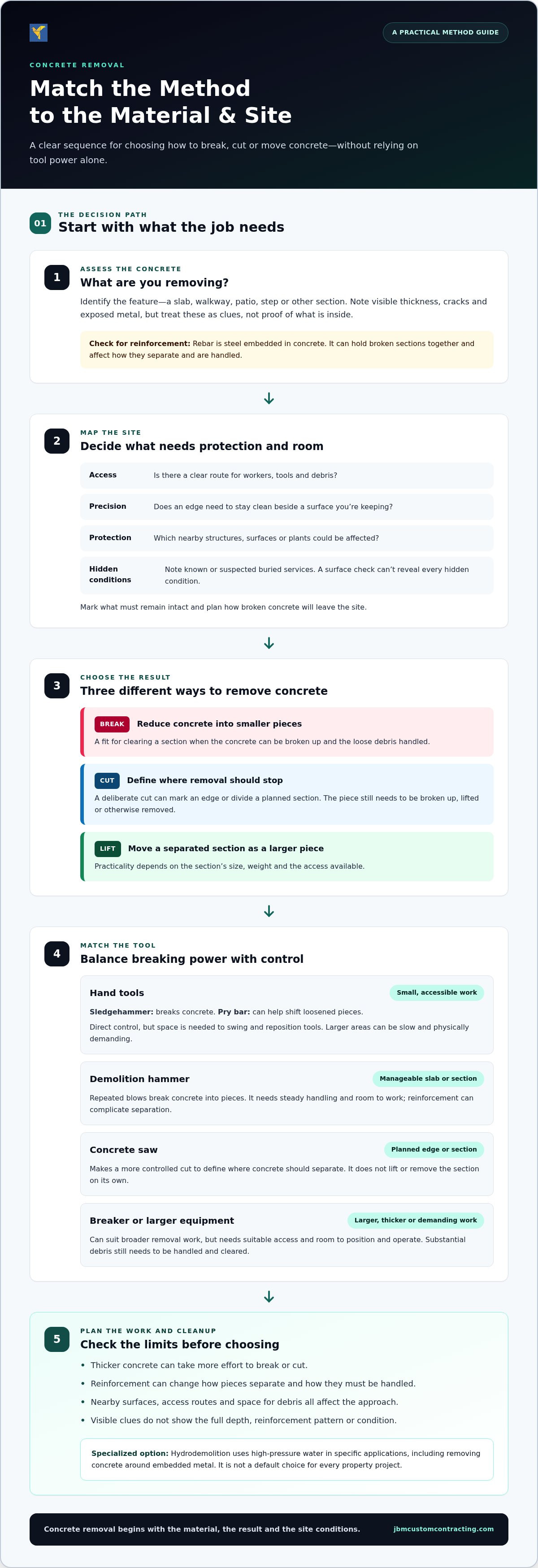
Concrete Removal Methods Compared: Breaking, Cutting or Lifting
Once you know what needs to stay and what can go, choose a method that suits the result you want. Breaking, cutting and lifting solve different problems. Breaking clears concrete by reducing it to smaller pieces. Cutting defines where removal should stop. Lifting moves a separated section as a larger piece when its size, weight and access make that practical.
For a patio being fully replaced, breaking may be a straightforward fit. If only one strip beside a garden path needs to come out, a cut boundary can help separate the work area from the concrete that will stay. A section that needs to be removed intact may call for separation and lifting, but that depends on how it was built and whether it can be handled and moved safely.
- Breaking: Suits full removal where fragments are acceptable. Breaks may be less precise along the edge.
- Cutting: Helps define an edge or planned section. Cutting alone doesn’t remove the concrete.
- Lifting: Can move a separated section in larger pieces, but requires suitable access and a workable way to handle them.
Is breaking concrete into pieces the right approach?
Breaking can make sense when the entire feature is being removed and a clean retained edge isn’t the main goal. A walkway or patio slated for replacement may be cleared this way, with the concrete reduced to pieces for removal. The trade-off is control: breaks may not follow a neat line. Near walls, steps, landscaping or finishes, plan where and how the concrete will be broken so the work stays focused on the section being removed.
When does cutting or selective removal help?
Saw-cut boundaries can create a clearer edge where concrete is to remain, such as when removing one section of a larger walkway. This selective approach separates the intended work area from the surrounding concrete before the unwanted part is broken out or otherwise removed. The cut helps define the boundary, but it doesn’t protect nearby surfaces on its own. The site layout, concrete construction and removal goal all shape the work sequence.
Methods can also be combined. A planned cut may define the perimeter, followed by breaking within that boundary and lifting or clearing the resulting pieces. In another setting, separating a section for lifting may reduce breakage, but only if access and handling conditions allow it. The sequence should account for edge control, working room, nearby surfaces and debris removal.
That’s why concrete removal tools and techniques work best as part of a coordinated plan, rather than as a choice between powerful tools. Project scope and site conditions shape professional work. JBM Custom Contracting’s concrete work and small demolition services can help with projects where the removal area or surrounding conditions call for a considered approach. For more detail, see this concrete removal services guide.
Plan Concrete Removal Safely: Site Preparation, Debris and Limits
A sound removal plan covers more than how concrete will be broken or cut. Before work starts, define the area, protect what’s staying, make sure there’s a workable route in and out, and decide how debris will be handled. These steps help organize the job and reduce the chance of damage to nearby surfaces, structures or landscaping.
Buried services and hidden conditions need particular care. If the location of underground utilities is uncertain, or the site presents conditions you can’t assess confidently, pause and arrange an appropriate qualified assessment before demolition begins. A tool can’t make an unknown site safe.
What should be prepared before concrete demolition starts?
Mark the intended removal boundary clearly, then identify nearby walls, steps, paving, garden beds and other features that need protection. Plan the full route, not just the work area: workers and tools need access, and broken material must be moved out without damaging surfaces along the way. For coordinated work involving concrete and other structures, JBM’s small demolition services can address the project as a whole.
- Define: Mark the concrete to remove and distinguish it from sections that must remain.
- Protect: Identify surrounding surfaces and landscaping that need site-specific protection.
- Plan access: Consider how equipment will reach the area and how debris will leave it.
- Assess: Resolve uncertainty about buried services or concealed conditions before work begins.
Access can shape the work plan. A narrow side yard, for example, may limit where tools can be positioned and how broken pieces can be carried out. If you overlook the exit route, debris can pile up in the work area and make movement harder. Include the route for removing material in your preparation, not as an afterthought.
How should removed concrete and the work area be managed?
Plan for the full debris cycle: breaking or separating concrete, lifting or gathering pieces, sorting and loading them, then clearing the work area. The size and amount of debris affect what can be moved through the available access. Check current local disposal and recycling guidance for the project location, since accepted materials and options can vary. Don’t assume every facility handles concrete in the same way.
Dust, noise and flying fragments are practical concerns during concrete work. The right controls depend on the tools, site layout and nearby people or property. Consider how the work area will be separated, how dust will be managed and how exposure to noise and fragments can be reduced. If conditions change, reassess the setup rather than pressing ahead with the original plan.
Good preparation connects the chosen concrete removal tools and techniques to access, protection and cleanup. For substantial work or a complicated site, professional planning can help coordinate those moving parts before demolition starts.
When Professional Concrete Removal Is the Practical Next Step
Some concrete projects are manageable with basic tools and a clear work area. Others are more demanding because of the material, access or the need to protect what’s around them. Thick or reinforced concrete, restricted routes for moving debris and precise boundaries beside a structure all make careful planning important. Not every removal job needs machinery or professional help. The method should match the conditions, not just the size of the area.
Which projects can be difficult to manage as DIY work?
Consider professional support if the concrete is substantial, reinforcement is present, access is tight or the edge must meet a surface that’s staying. Work near walls, steps and finished landscaping leaves less room for uncontrolled breaks. Uncertain buried services or concealed site conditions also call for an appropriate assessment before work begins. These factors can make tool selection, work sequence and debris movement harder to manage.
Think beyond the breaking stage. Concrete must also be separated, lifted or gathered, moved through the available access and cleared from the work area. A project that seems small from above may be difficult if there’s no practical route for carrying out heavy pieces. The reverse can also be true: a larger, open area may allow a straightforward plan. A professional assessment can clarify the scope and identify site constraints before removal starts.
What does a coordinated concrete removal project involve?
A coordinated plan connects the removal method with site preparation, protection and cleanup. It establishes what will be removed, what must remain intact, how the work area will be protected and how broken material will be handled. If conditions change during the work, the approach may need to change too. This planning helps limit avoidable disruption and keeps removal and cleanup connected.
JBM Custom Contracting provides concrete work and small demolitions for homes and businesses in its Vancouver Island service area. As a certified and fully insured company, JBM can bring those services together for property projects where the removal work and site conditions need to be considered as a whole. Choosing the right concrete removal tools and techniques is part of the plan, along with protecting the site and clearing debris.
You don’t need to settle on equipment before discussing the project. If the concrete is reinforced, access is limited or nearby features need careful protection, a professional conversation can help identify a sensible next step.
Discuss your concrete removal project
Make Your Next Concrete Project Easier to Plan
Turn what you’ve learned into a clear plan for your property. Before work begins, consider what needs to remain untouched, how concrete and debris will leave the site, and whether the conditions are straightforward enough to manage yourself. If the work involves uncertainty or tight tolerances, an experienced perspective can help you plan the next step.
The right concrete removal tools and techniques are part of a larger decision: how to complete the work while respecting the site around it. JBM Custom Contracting provides concrete work and small demolitions, with a practical approach shaped around the project.
Share what you’re planning and decide on the next step with the site, access and cleanup in mind.
Discuss your concrete removal project
A well-planned project starts with a clear conversation. You can move ahead with confidence.
Frequently Asked Questions
What is the best tool for breaking up concrete?
Choose a tool based on the finish you need and the pieces you can realistically handle, rather than looking for one universal best option. When comparing concrete removal tools and techniques for a home project, first decide whether irregular fragments are acceptable or whether you need a more defined edge. Consider whether you can control the tool comfortably throughout the task. If not, a professional assessment can help clarify a practical approach.
Can you remove concrete without a jackhammer?
Yes, a jackhammer isn’t essential for every project. For a small repair, you may only need to remove loose or damaged material around the area being fixed, rather than take out an entire slab. Keep the work within the intended repair area. If the concrete is firmly attached, reinforced or part of a larger feature, hand removal may be difficult to control, and a professional assessment may be more sensible.
How do you remove a concrete slab in pieces?
Plan the removal around pieces that can be handled and moved through the available route, rather than breaking concrete without a clear endpoint. Before starting, identify where each piece will go and how it will be taken away from the work area. A narrow gate or steps can make even manageable fragments awkward to move. If the slab’s construction or weight is uncertain, don’t assume it can be lifted safely by hand.
Is it safe to break up concrete yourself?
It can be manageable for a small, clearly understood task, but safety depends on more than the tool. Stop if the concrete is connected to a structure, you can’t tell what’s beneath it or you’re unsure how to control the work. Use protective equipment suited to the task and keep people away from the active area. If you can’t confidently manage the material and surroundings, leave the removal to a qualified professional.
Do you need to cut concrete before removing it?
No. A cut is useful when a defined boundary matters, but it may be unnecessary if the whole feature is being removed. Check whether an existing joint or clear break already separates the section from concrete that will stay. Don’t assume a visible line is a safe separation point; the concrete may continue below the surface. If the boundary is important and unclear, have the site assessed before choosing where to cut.
What happens to concrete after it is removed?
Its next destination depends on the material’s condition and what local facilities accept. Before removal, find out whether concrete needs to be kept separate from soil, wood or other debris for a recycling option. Check current guidance for the project location. Property owners in Nanaimo, Lantzville, Duncan, Ladysmith, Cedar, Parksville, Qualicum Beach, Cowichan and Gabriola Island should review local disposal and recycling information before arranging transport.
Planning concrete removal in Nanaimo, Lantzville, Duncan, Ladysmith, Cedar, Parksville, Qualicum Beach, Cowichan or Gabriola Island? Contact JBM Custom Contracting to discuss your concrete work or small demolition project.